Introduction
If you want financial freedom, you need more than motivation – you need a financial freedom planner that turns “someday” into a 30-day plan you can follow.This guide is for you if you’re tired of guessing, juggling bills, or making budgets that only work for a week.
In the next sections, you’ll build a clear path: define what financial freedom means for you, audit your money baseline, and set up a simple budget, savings plan, and debt payoff strategy.Then you’ll follow a short action schedule and measure progress weekly, so you can adjust without giving up.You’ll also get a bit of real-world context about why personalized planning matters, including how professional advisors frame a “customized path to financial freedom” for clients (Creative Planning, https://creativeplanning.com/about/).
Key Takeaways
- Define financial freedom for yourself with specific, measurable goals (e.g., pay off high-interest debt, build a safety buffer) so progress is obvious.
- Audit your money baseline by reviewing 1-3 months of transactions, tagging spending, and targeting repeatable leaks like forgotten subscriptions or rising fees.
- Build a 30-day budget with realistic categories (needs, wants, savings, debt) and track simply (weekly or lightweight daily) to stay consistent.
- Create a savings and emergency fund roadmap: start with an achievable milestone, prioritize consistency, and automate transfers to prevent spending creep.
- Prioritize debt using balances, interest rates, minimums, and cash-flow impact; if cash is tight, prevent new debt even if it slows repayment temporarily.
Set your direction with a financial freedom planner
Start by defining financial freedom for your life, not someone else’s.For you, it might mean paying off high-interest debt, building a safety buffer, or reducing stress so you can choose work – or not – without panic.Keep it specific enough that you can tell progress when you see it.
Next, choose measurable goals and timelines you can track daily.Good goals feel concrete: “Add $200 to savings this month,” “Pay $300 toward credit cards,” or “Spend no more than $150 on eating out this week.” Then set a realistic 30-day target that supports the bigger picture.Think of this planner like your map: it doesn’t guarantee the ride goes perfectly, but it stops you from driving without direction.
Audit your money baseline: income, expenses, debt, and cash flow

Average American household income, expenses, and debt statistics for 2023.
Before you change anything, map your recurring spending and find your biggest budget leaks.Pull your last 1-3 months of bank and card transactions, and tag spending into simple buckets.Look for patterns like “same date charges,” subscriptions you forgot, or categories that quietly balloon (like fees, delivery, or impulse buys).Those are usually the easiest wins because they’re repeatable.
Then calculate debt payoff priorities and monthly impact.List each debt with balance, interest rate (if you have it), minimum payment, and due date.From there, decide what you’ll pay extra on and how that changes your monthly cash flow.If your cash flow is tight, you might need to focus on preventing new debt first, even if it slows repayment temporarily.
You’ll also benefit from using reputable planning tools to organize your numbers, like the free resources from the U.S.Securities and Exchange Commission’s investor education site (https://www.investor.gov/free-financial-planning-tools).
Build your 30-day budget system you can actually follow
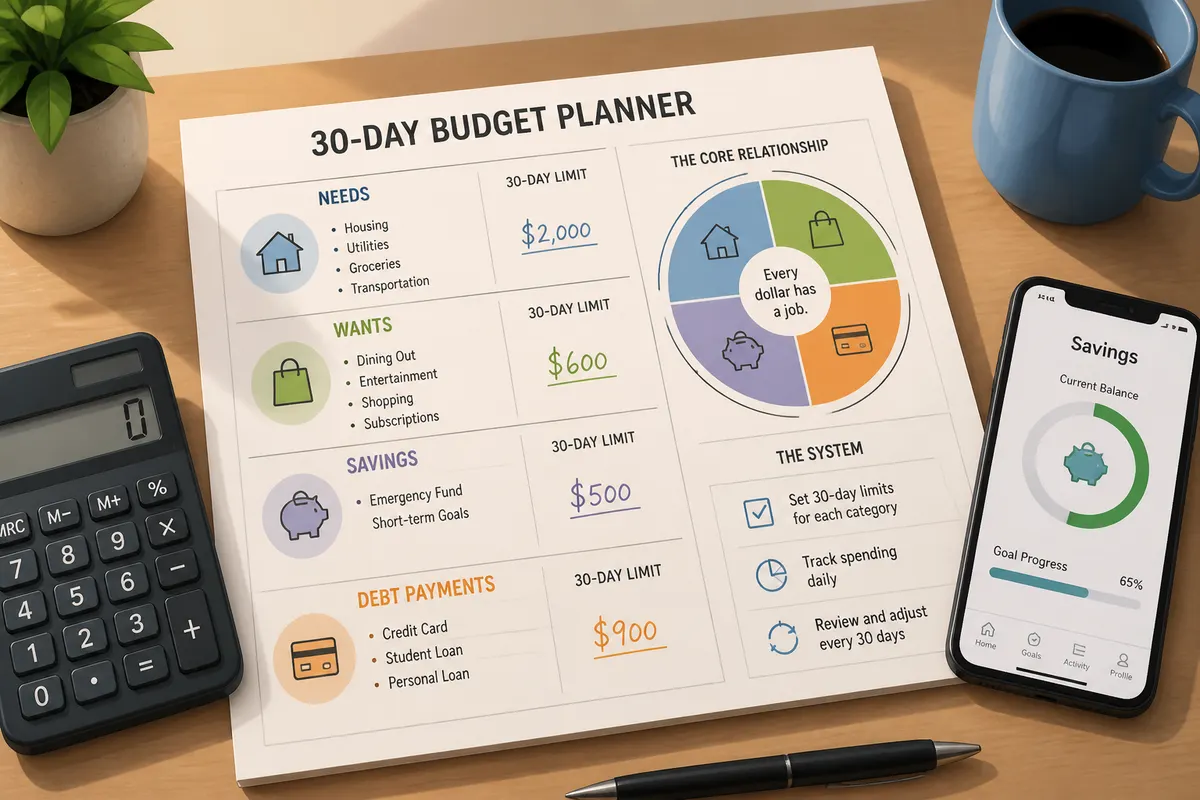
A photographic view of building a 30-day budget system toward financial freedom.
Your budget should match how you live, not how spreadsheets work.Create categories for needs, wants, savings, and debt payments, then assign a realistic dollar limit to each.Needs cover essentials like housing, utilities, groceries, and transportation.Wants are everything else you choose – dining out, entertainment, shopping – and those limits protect your plan.
Now pick a simple daily or weekly tracking method so you stay on plan.Many people do better with weekly check-ins because transactions stack up, but daily tracking can work if you keep it lightweight.Choose one approach and stick to it: a notes app total, a budgeting app, or a paper tracker with a “spent so far” column.
| Category | What goes here | Tracking style | 30-day goal example |
|---|---|---|---|
| Needs | Rent/mortgage, utilities, groceries, transport | Weekly total | Stay within your baseline bills |
| Wants | Food out, hobbies, subscriptions, shopping | Daily check | Cap eating out at $150 |
| Savings | Emergency fund, short-term goals | Automatic + weekly review | Add $200 this month |
| Debt payments | Minimums + extra principal | Monthly schedule | Pay $300 extra toward card A |
Tip: If your budget feels strict, start with the easiest category to control – often “wants.” When that improves, you’ll gain confidence to fine-tune the rest.
Create your savings and emergency fund roadmap
Build a savings plan with a target you can actually reach.Set an achievable emergency fund target and contribution pace based on your current cash flow.A common way to start is to aim for a small first milestone, then grow it.The key is consistency over perfection – one month of steady saving beats a perfect plan you abandon.
Next, automate transfers and protect savings from spending creep.When money moves on a set schedule, you reduce the chance that “just this once” turns into repeated delays.If you have multiple accounts, consider separating emergency savings from everyday checking so it’s less tempting to dip into it.
You can also lean on guidance from credible nonprofit resources on building financial resilience, like the Federal Deposit Insurance Corporation’s consumer information on saving and banking basics (https://www.fdic.gov/consumer-information).And if you’re learning the fundamentals, the U.S.Department of the Treasury’s consumer resources can help you build healthier habits around budgeting and saving (https://home.treasury.gov/about/general-information/consumer-tips).
Take control of debt with a structured payoff plan
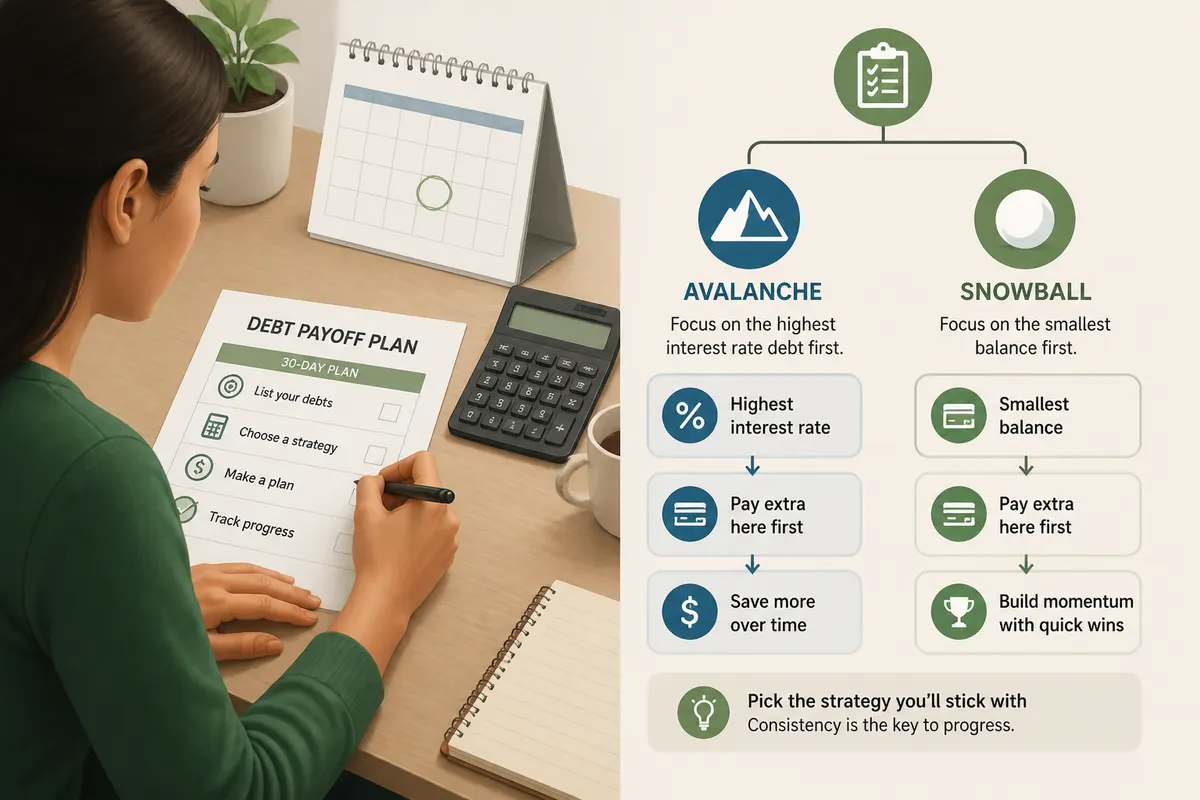
Taking control with a structured debt payoff plan
Now, turn debt into a plan you can follow for the next 30 days.Pick a payoff strategy: avalanche vs. snowball.Avalanche targets the highest interest rate debt first, which usually saves the most money over time.Snowball focuses on the smallest balance first, which can boost motivation because you’ll see wins sooner.Choose the method you can stick with.
Also, reduce interest and prevent new debt while paying down balances.That usually means two moves: pay at least the minimums on everything, and direct extra payments toward your chosen target debt.If you’re tempted to keep using credit while paying it down, pause new charges for the month and treat your available credit as a “do not touch” buffer.
For practical guidance on credit and debt management, you can use trusted educational resources such as the Consumer Financial Protection Bureau’s debt collection and credit card consumer topics (https://www.consumerfinance.gov/consumer-tools/credit-cards/) and their general consumer education site (https://www.consumerfinance.gov/consumer-tools/).
Warning: Don’t chase a “perfect” payoff plan while your budget is missing basics. If cash flow is unstable, your first priority is stopping new debt while you stabilize spending.
Follow a 30-day action schedule and measure progress weekly
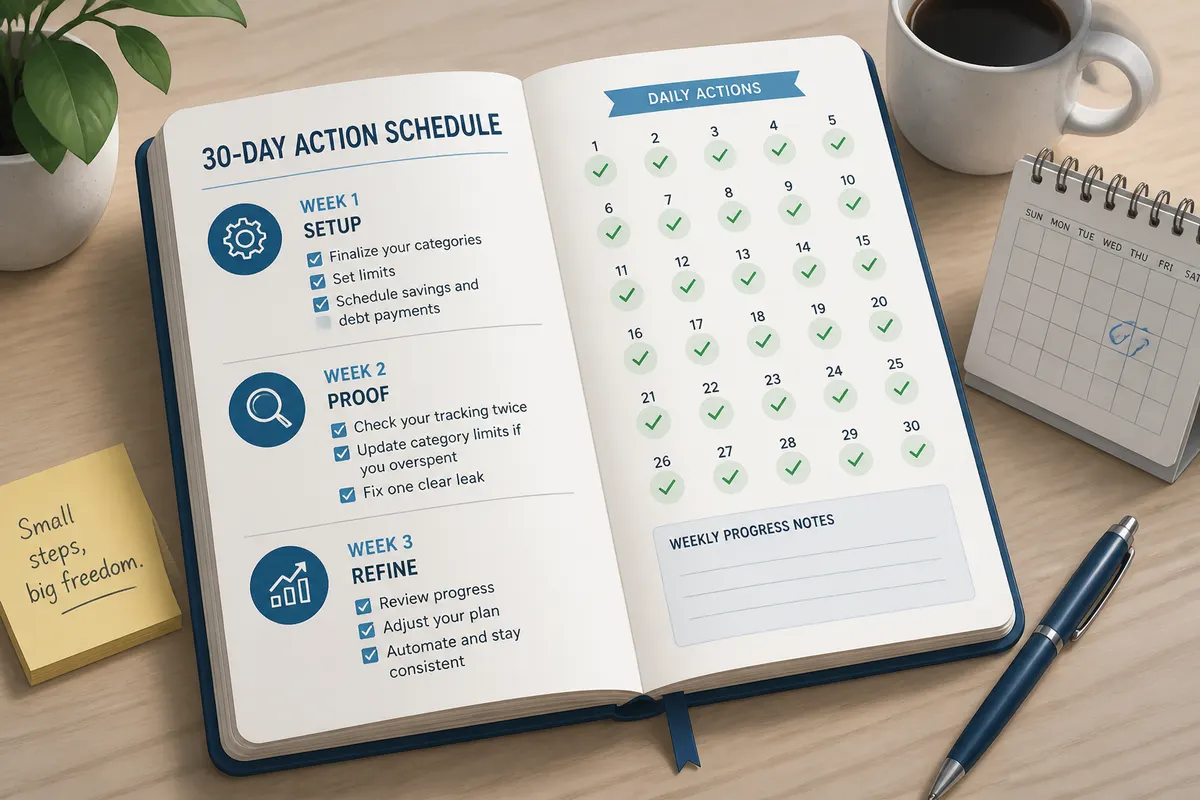
Tracking daily progress on a 30-day financial freedom action schedule.
Your plan works only if you run it.Use a week-by-week checklist to plan, track, adjust, and stay consistent.Week 1 is setup: finalize your categories, set limits, and schedule savings and debt payments.Week 2 is proof: check your tracking twice, update category limits if you overspent, and fix one clear leak.Week 3 is focus: keep the same structure, but tighten the “wants” category.Week 4 is review: compare planned vs. actual, then decide what to carry forward.
Then measure progress with metrics that show momentum, not just perfection.Track things like: amount saved, debt balance reduced, days under budget for wants, and on-time payment consistency.If your spending drifted, you’re not failing – you’re learning what needs a tighter limit or a different plan.
- Weekly money check-in (10-15 minutes): planned vs. actual spending totals.
- One adjustment only: change a limit or tweak a transfer – don’t overhaul everything.
- One “friction” move: remove or limit the trigger (unsubscribe, block sites, pause delivery apps).
To keep your thinking grounded, you can browse free planning tools from official consumer education sources, including the Investor.gov planning tools that encourage you to organize your financial picture (https://www.investor.gov/free-financial-planning-tools).
Conclusion
You don’t need a life overhaul to start earning financial freedom – what you need is a repeatable system.After 30 days, keep the system and continue improving: refine your categories, raise savings slowly, and keep directing extra debt payments toward your chosen target.If something went wrong, use it as a signal, not a verdict.
When you keep returning to your plan, your next steps become clearer.That’s why a personalized approach matters; for example, some professional planning firms describe helping clients simplify their journey to financial wellness with a customized path to financial freedom (Creative Planning, https://creativeplanning.com/about/).If you’re ready to stay consistent, your financial freedom planner becomes more than a document – it becomes your daily decision framework.
Frequently Asked Questions
What is a financial freedom planner and how does it help me go from “someday” to a 30-day plan?
A financial freedom planner is a step-by-step framework that turns vague goals into a short, trackable action plan. Instead of relying on motivation, it helps you define what financial freedom means for you, audit your current money baseline, set up a simple budget, savings plan, and debt payoff strategy, then follow a brief action schedule and review progress weekly so you can adjust without giving up.
How do I define financial freedom for my own life using this planner approach?
Start by defining financial freedom in your own terms – not someone else’s. For many people, it can mean paying off high-interest debt, building a safety buffer, or reducing stress so you can choose work (or not) without panic. The key is to keep it specific enough that you can clearly recognize progress when it happens.
What should I audit first when building a financial freedom plan?
Begin by auditing your money baseline – your current starting point. The planner approach emphasizes not guessing or juggling bills without a plan. From there, you can create a realistic budget, determine what to prioritize first, and set targets that you can measure and track over time.
How do I set measurable financial goals and timelines I can actually track daily?
Use measurable, concrete goals tied to timelines – goals that let you see progress quickly. Examples from the approach include targets like adding a specific amount to savings in a month or paying down a set amount of debt. Then map those goals into a schedule you can follow daily or consistently.
How should I structure a simple budget as part of a financial freedom planner?
Use the planner’s core structure: create a budget that supports three areas – spending control, savings, and debt payoff. The goal is to stop making budgets that only work for a week and instead set up a system you can follow while you measure progress weekly and make adjustments.
What is the debt payoff strategy recommended in a financial freedom planner?
The approach highlights prioritizing high-interest debt as a common definition of financial freedom. Practically, that means building your plan so your actions each week support paying down that debt according to a measurable timeline, alongside budgeting and savings so you’re not stuck cycling bills.
How does weekly progress measurement work in a financial freedom planner?
After you set up your budget, savings plan, and debt payoff strategy, you follow a short action schedule and measure progress weekly. The weekly check-in helps you adjust your plan based on what’s working (or what isn’t) without losing momentum.
Why does personalized financial planning matter, and how do professional advisors frame it?
Personalized planning matters because financial freedom looks different for each person and requires a customized path. The source mentioned (Creative Planning) emphasizes helping clients simplify their journey to financial wellness through personalized planning, aligning with the planner approach of defining financial freedom for your life and tailoring goals and actions to your baseline.