
Introduction
When your pay increases, it’s easy to upgrade your apartment, car, and weekend plans before deciding what the extra money should do for your future. A stronger approach is to set a saving and investing plan first, then choose the lifestyle you can comfortably support. That’s one practical lesson behind many habits of wealthy people: lasting financial progress often comes from steady decisions, not dramatic shortcuts.
You can build those decisions into your own routine, whether you’re paying off debt, growing savings, or beginning to invest. This guide walks you through seven useful wealth habits, with clear actions you can adapt to your income and priorities. You don’t need a large starting balance to begin; you need a plan that leaves room for everyday needs while moving you toward goals that matter.
Before you begin: Gather a recent pay statement, bank and debt balances, and a list of essential monthly expenses. You’ll use them to see where your money goes and choose a realistic first step. Treat each habit as a flexible practice, not a promise of guaranteed wealth. Your circumstances, responsibilities, and comfort with risk should shape your decisions.
Key Takeaways
- Keep lifestyle costs from absorbing income gains: Decide how raises will support savings, debt repayment, or investing before adding new expenses, and choose spending changes you can sustain.
- Use a budget that reflects real priorities: Build a monthly plan from actual income and spending, assign money to essentials and goals, and leave a buffer for irregular costs.
- Build accessible emergency savings: Start with a reachable savings milestone and grow a reserve suited to your expenses and responsibilities. Keep it accessible rather than investing money you may need urgently.
- Invest regularly with risks in mind: After covering essential bills and building a workable cash reserve, make contributions that fit your budget and time frame. Understand fees and risks, and avoid relying on past performance.
- Repay high-interest debt without neglecting essentials: Make required payments, then consider directing extra money to the highest-rate balance to reduce interest. Protect essential expenses and choose a repayment method you can maintain.
- Turn goals and learning into ongoing habits: Translate financial ambitions into a target, time frame, and monthly action. Keep learning about money and relevant career skills, while checking advice and costs against your circumstances.
1. Spend Less Than You Earn and Resist Lifestyle Inflation

Keep Spending Below Your Income as Earnings Grow
Start by comparing your take-home income with your regular spending. Include housing, food, transport, bills, debt payments, and the small purchases that can disappear from memory. If you earn more later, decide how much of the increase will go toward savings, debt, or investing before adding new expenses. This helps you keep a gap between what comes in and what goes out.
For example, if a raise adds $300 to your monthly take-home pay, you might direct $200 toward a goal and use the rest for a planned improvement. The exact split depends on your needs. Review subscriptions, frequent delivery orders, and other flexible costs, but don’t cut so aggressively that your plan becomes hard to follow. Choose changes you can sustain.
- Set an automatic transfer after payday, even if you begin with $25.
- Wait a day before making a nonessential purchase, then check it against your priorities.
Wealth habits aren’t about avoiding every pleasure. They’re about making sure rising expenses don’t quietly absorb every increase in income.
2. Follow a Budget That Reflects Your Priorities

Review Cash Flow and Give Every Dollar a Purpose
Build a simple monthly plan from actual income and recent spending, rather than guesses about what you “should” spend. Separate essential bills, flexible spending, savings, and debt payments. If your income changes from month to month, use a cautious estimate and assign extra money after you receive it. A budget should help you make choices, not make you feel punished.
Try reviewing your accounts once a week for ten minutes. You could use a spreadsheet, a banking tool, or paper; the useful method is the one you’ll keep using. If groceries regularly cost more than your estimate, adjust the category instead of treating a normal mismatch as failure. The Consumer Financial Protection Bureau’s budgeting resources can help you organize income and expenses.
| Money category | What to include | Question to ask |
|---|---|---|
| Essentials | Housing, food, utilities, transport | Are these costs covered first? |
| Goals | Emergency savings, debt, investing | What amount can you set aside? |
| Flexible spending | Eating out, hobbies, nonessential shopping | Does this match your priorities? |
Give each dollar a job while leaving a small buffer for irregular costs. That buffer can keep one unexpected bill from disrupting your whole plan.
3. Build an Emergency Fund Before Taking Bigger Risks

Set a Practical Savings Target for Unexpected Expenses
Set aside money for costs that are urgent, necessary, and hard to predict, such as a repair, medical bill, or temporary loss of income. Start with a first milestone you can reach, perhaps $500 or $1,000, then build from there. Your longer-term target should reflect your essential expenses, job stability, household responsibilities, and access to other support. A single target won’t suit everyone.
For instance, if your essential costs are about $2,400 a month, saving one month of those expenses would give you a useful initial cushion. You might later work toward several months, adding gradually rather than delaying until you can save a large amount. Keep this money accessible and separate from everyday spending. The FDIC’s guidance on saving for emergencies offers more context on building a reserve.
- Choose a regular transfer that won’t cause you to miss essential bills.
- Use the fund only for genuine emergencies, then make a plan to replenish it.
Important: Don’t put emergency money into investments that can lose value or take time to access. A reserve is there to protect your choices when life gets expensive, not to chase returns.
4. Invest Consistently for Long-Term Growth

Use Regular Contributions and Understand Risk
Once your essential bills are covered and you have a workable cash reserve, learn how investing fits your time frame and risk tolerance. Start by understanding the account options available to you, any fees, and what you’re buying. Regular contributions can make investing a habit instead of a decision you revisit only when markets feel calm. You can begin with an amount that fits your budget.
For long-term goals, a steady plan you understand can be easier to maintain than a series of rushed reactions to market swings.
For example, contributing $100 monthly adds up to $1,200 in contributions over a year, before any investment gains or losses. That arithmetic isn’t a return forecast; your balance can rise or fall. Diversification can spread your money across different investments, though it can’t remove all risk. Review Investor.gov’s explanation of mutual funds and exchange-traded funds and FINRA’s overview of asset allocation as you learn.
Choose an approach you can explain in plain language, then review it when your goals or circumstances change. Avoid investing money you’ll need soon, and don’t treat past performance as a guarantee of future results. If you’re unsure about taxes, fees, or risk, seek qualified guidance before acting.
5. Pay Down High-Interest Debt Strategically

Prioritize Costly Balances While Protecting Essential Cash Flow
List each debt, its balance, minimum payment, and interest rate. Keep making every required payment, then direct extra money toward the balance with the highest rate if reducing total interest is your priority. Another option is to clear the smallest balance first for a quick sense of progress; that can help you stay engaged, though it may cost more interest. Pick a method you can stick with.
Suppose you have two balances and can put an extra $75 a month toward debt. Compare their rates and terms before choosing where that extra payment goes. Don’t skip rent, utilities, essential food, or minimum debt payments to accelerate repayment. If you’re having trouble keeping up, contact your lender early and review the CFPB’s information on debt and consumer protections before agreeing to a new arrangement.
- Pause new discretionary borrowing while you work through the balances.
- Check statements for fees and confirm how extra payments are applied.
When a debt is paid off, redirect its former payment toward your next balance or savings goal. That way, progress can continue without requiring a bigger monthly budget.
6. Keep Learning About Money and Improve Your Skills
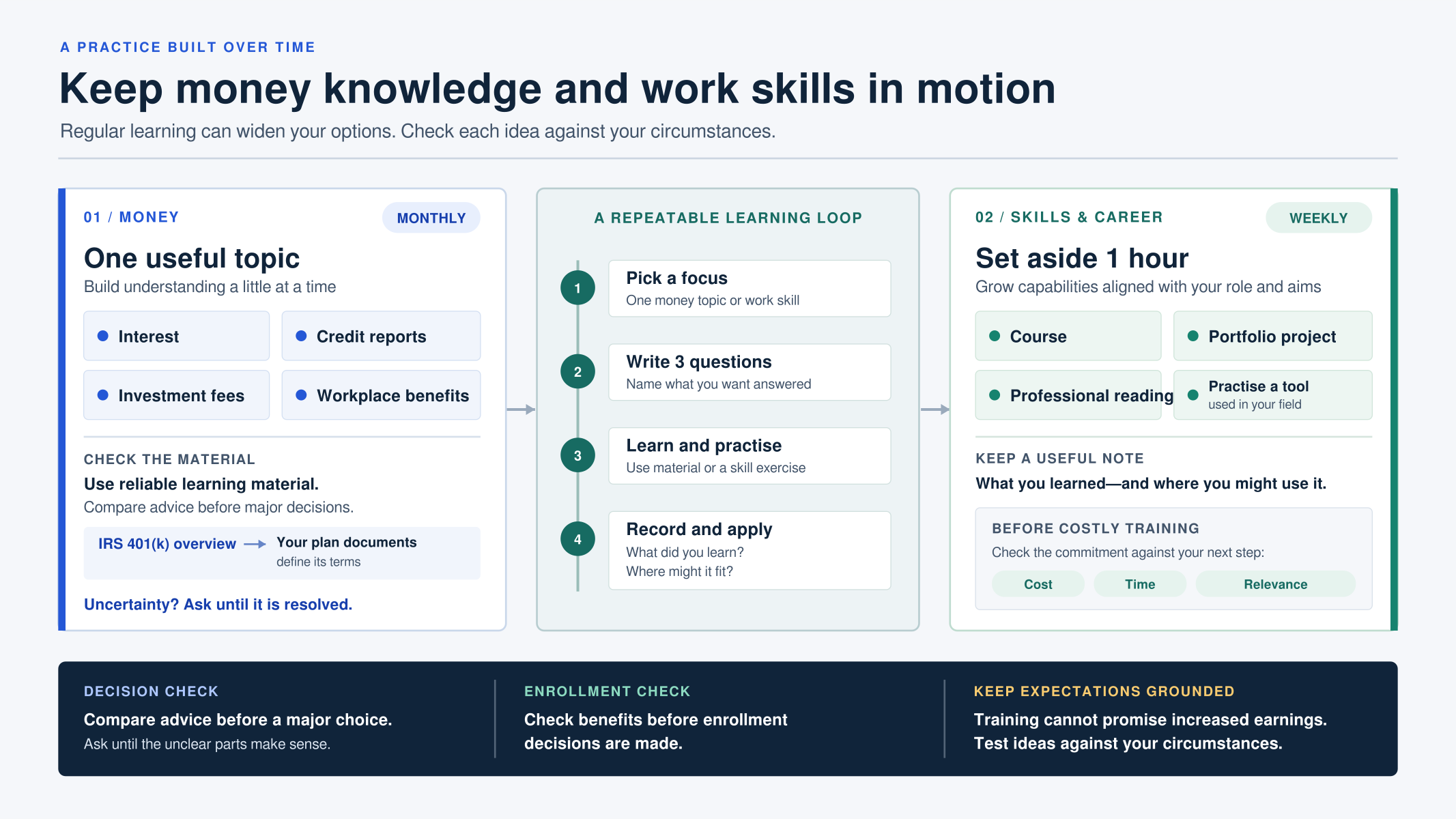
Make Financial Education and Career Development Ongoing Habits
Set aside a little time each month to learn one useful topic, such as interest, credit reports, investment fees, or workplace benefits. Use reliable educational material and compare advice before making a major decision. The Internal Revenue Service’s overview of 401(k) plans can help you understand a common workplace retirement plan, though your own plan documents determine its terms. Ask questions when something is unclear.
Your earning power matters too, so keep building skills that fit your work and goals. You could set a weekly hour aside for a course, portfolio project, professional reading, or practice with a tool used in your field. Then note what you learned and how you might apply it. Avoid expensive training until you’ve checked the cost, time commitment, and relevance to your next career step.
- Choose one financial topic and write down three questions you want answered.
- Review your workplace benefits before making enrollment choices.
Consistent learning can help you make better-informed decisions, but no course or credential guarantees a higher income. Treat new knowledge as a way to widen your options, then test it carefully against your circumstances.
7. Set Clear Financial Goals and Track Your Progress
Turn Long-Term Ambitions Into Measurable Milestones
Translate broad hopes such as buying a home, building retirement savings, or becoming debt-free into a target, time frame, and monthly action. If you want to save $3,600 in two years, a simple starting calculation is $150 per month, before interest or changes in costs. Adjust the amount if it strains your budget. A useful goal should guide decisions without making normal setbacks feel like defeat.
Track a few measures that connect to your plan: emergency savings, debt balances, contributions, or progress toward a deposit. Update them monthly or quarterly, not every hour. The point is to spot patterns and make a thoughtful adjustment, rather than react to each small change. If a goal becomes unrealistic after a job or family change, revise the timeline and keep the purpose.
| Goal | Milestone to track | Review question |
|---|---|---|
| Emergency fund | Amount saved toward your chosen target | Can you increase the transfer safely? |
| Debt reduction | Balances and required payments | Is extra money going to the intended debt? |
| Long-term investing | Contribution consistency | Does your plan still fit your time frame? |
Write your next action on your calendar, such as checking balances on the first weekend of each month. Clear follow-through turns a goal from an idea into a routine.
Conclusion
You can strengthen your financial future by spending below your means, giving your money a plan, building a reserve, and making informed choices about investing and debt. Learning steadily and tracking a few meaningful goals can help you stay focused as your circumstances change. These habits of wealthy people aren’t a shortcut or a promise of a particular outcome; they’re practical ways to make decisions with more intention.
Choose one action to start this week. You might review last month’s spending, set an affordable automatic transfer, or list your debts by interest rate. Keep the first step small enough to repeat, then build on it as your confidence and resources grow. When you review your plan, protect essentials first and make changes that fit your actual life.
Your financial future won’t be shaped by one perfect month. It will reflect the choices you keep making, the information you seek, and the adjustments you’re willing to make along the way. Start with the habit that matters most right now, and give it time to become part of your routine.
Frequently Asked Questions
Frequently Asked Questions
What does “wealth habits” mean?
How can SMART goals support wealth-building habits?
Can habits outside of money management support financial success?
Should I copy the daily routine of a wealthy person?
Are small, regular actions more useful than a dramatic financial change?
How can I stay motivated when financial progress feels slow?
Can I develop wealth habits before I have a high income?
Do wealth-building habits require expensive tools or memberships?
Sources
- 10 Money Habits of Self-Made Millionaires – CNBC
https://www.cnbc.com/select/money-habits-of-self-made-millionairesCNBC Select describes ten money habits that a CFP says his wealthiest self-made millionaire clients follow.
- Daily Habits of Wealthy People – Yahoo Finance
https://finance.yahoo.com/news/daily-habits-of-wealthy-people-143505884.htmlYahoo Finance covers the daily habits of wealthy people.
- 10 Simple Habits of the Average Millionaire – Ramsey Solutions
https://www.ramseysolutions.com/retirement/habits-of-millionaires-and-billionairesRamsey Solutions outlines simple habits associated with average millionaires.
- 7 Habits Rich People Swear By to Build and Maintain Wealth
https://www.kiplinger.com/personal-finance/habits-rich-people-swear-by-to-build-and-maintain-wealthKiplinger covers seven habits rich people use to build and maintain wealth.
- 9 Things Rich People Do and Don’t Do Every Day – Business Insider
https://www.businessinsider.com/rich-people-daily-habits-2014-6Business Insider examines things rich people do and avoid doing each day.
- 5 Habits Wealthy People Follow – Barnum Financial Group
https://barnumfinancialgroup.com/5-habits-wealthy-people-followBarnum Financial Group discusses five habits wealthy people follow, including setting SMART goals.
- Habits of the wealthy: What do rich people do differently?
https://www.getrichslowly.org/wealthy-habitsGet Rich Slowly explores what wealthy people do differently.
- 9 Success Habits of Wealthy People That Cost Nothing – Entrepreneur
https://www.entrepreneur.com/living/9-success-habits-of-wealthy-people-that-cost-nothing/307635Entrepreneur covers nine no-cost success habits of wealthy people, including practices related to health and well-being.
- Consumer Financial Protection Bureau’s budgeting resources
https://www.consumerfinance.gov/consumer-tools/budgetingThe Consumer Financial Protection Bureau’s budgeting resources page provides information about budgeting.
- FDIC’s guidance on saving for emergencies
https://www.fdic.gov/consumer-resource-center/2024-07/saving-emergenciesThe FDIC’s guidance page covers saving for emergencies.
- Investor.gov’s explanation of mutual funds and exchange-traded funds
https://www.investor.gov/introduction-investing/investing-basics/investment-products/mutual-funds-and-exchange-traded-fundsInvestor.gov explains mutual funds and exchange-traded funds.
- FINRA’s overview of asset allocation
https://www.finra.org/investors/investing/investing-basics/asset-allocationFINRA’s overview introduces asset allocation.
- CFPB’s information on debt and consumer protections
https://www.consumerfinance.gov/consumer-tools/debt-collectionThe Consumer Financial Protection Bureau’s page covers debt collection and consumer protections.
- Internal Revenue Service’s overview of 401(k) plans
https://www.irs.gov/retirement-plans/plan-sponsor/401k-plan-overviewThe IRS overview covers 401(k) plans.
- The Wealthiest People Just Mimic These Habits. Don’t F*ck It Up.
https://timdenning.substack.com/p/the-wealthiest-people-just-mimicTim Denning’s article presents habits it says wealthy people mimic.
- What are some habits or skills that wealthy people have that I can …
https://www.reddit.com/r/Rich/comments/1dfqeyc/what_are_some_habits_or_skills_that_wealthyA Reddit discussion asks what habits or skills wealthy people have.
- Five Habits of Wealthy People That You Can Embrace
https://stephenblandino.com/2014/05/five-habits-wealthy-people-you-can-embrace.htmlStephen Blandino’s article outlines five habits of wealthy people that readers can embrace.
- Patrickeboyle Medium: Millionaire Habits That Could Change Your Life E576c3087c4
https://patrickeboyle.medium.com/millionaire-habits-that-could-change-your-life-e576c3087c4A Medium article titled “Millionaire Habits That Could Change Your Life” focuses on habits associated with millionaires.