Introduction
When your income depends entirely on hours worked, a change in your schedule can quickly affect your financial plans. Passive earning can give you another way to build cash flow, but it rarely means earning money without effort. You’ll usually invest money, time, or creative work upfront, then keep checking that your income source still works.
This guide walks you through seven practical approaches, from dividend investing and rentals to digital products and affiliate content. You’ll learn how each one can produce income, what to check before you commit, and where ongoing work or risk may appear. For a broad introduction to different passive income ideas, you can also review [U.S. Bank’s overview](https://www.usbank.com/financial-education/save/passive-income.html) and [Fidelity’s guide](https://www.fidelity.com/learning-center/smart-money/passive-income-ideas).
Before you begin: Set aside time to check your budget, savings, skills, and comfort with risk. You’ll also want a way to track income and expenses, plus a clear idea of your goal. Start with these actions:
- Choose an income approach that matches your resources.
- Research its costs, risks, and ongoing demands.
- Start small, track results, and adjust your plan.
Key Takeaways
- Passive earning still takes upfront work: These income approaches generally require money, time, or creative effort upfront, plus ongoing checks and adjustments to keep them working.
- Dividend payments are not guaranteed: Companies can reduce or stop dividends, so review their finances, debt, payment history, and your exposure to any one company or sector.
- Rental income comes with costs and responsibilities: Estimate expenses, repairs, vacancies, and local rules before relying on rent; managing tenants and property upkeep remains part of the work.
- REITs offer property exposure without direct ownership: REITs can provide access to income-producing real estate without buying a building or finding tenants, but distributions and share prices can change.
- Creative income depends on demand and upkeep: Digital products and licensed creative work may continue earning after creation, but success depends on useful content, buyer demand, rights, and platform terms.
1. Passive Earning Through Dividend Investing

Dividend investing can add regular cash payments to your investment plan. When a company shares part of its earnings with shareholders, you may receive a dividend based on the number of shares you own. Payments aren’t guaranteed, though: a company can reduce, pause, or stop them. You can take the cash or, if your account allows, reinvest it to buy more shares.
Use these checks to assess whether a dividend may fit your investment plan; payments and returns are not guaranteed.
| What to review | What to look for | Why it matters |
|---|---|---|
| Company earnings and cash flow | Whether the business generates cash and earnings that can support its dividend | A payout that the company cannot sustain may be reduced or stopped. |
| Dividend payout ratio | The share of earnings paid out as dividends, considered alongside the company’s industry and history | A very high ratio can leave less room to manage setbacks or invest in the business. |
| Debt and financial obligations | Debt levels, interest costs, and upcoming repayment needs | Financial commitments can affect the cash available for shareholder payments. |
| Dividend history | Past payment changes, including cuts or pauses | Past payments offer context, but do not guarantee future dividends. |
| Portfolio concentration | How much of your portfolio depends on one company or sector | Spreading investments can help limit exposure to a single business or industry. |
How Dividend Payments Create Ongoing Income
Start by learning how a company earns money and whether its finances appear able to support its dividend. A high payment compared with a share price may look attractive, but it can also signal greater risk. Compare a company’s history and business outlook rather than judging it on one figure. For an illustrative calculation, 100 shares paying $0.50 per share would produce $50 before taxes for that payment period; future payments and share prices could change.
Balance Yield, Diversification, and Risk
Spread your investments across companies and industries instead of relying on one dividend payer. You might compare a dividend-focused fund with individual shares, considering fees, holdings, and how much risk you can accept. Don’t invest money you need soon in assets whose value can fall. [Navy Federal’s passive income guide](https://www.navyfederal.org/makingcents/investing/15-passive-income-idea-to-generate-cash-flow.html) also discusses dividend stocks among several income approaches.
2. Earn Rental Income From Property
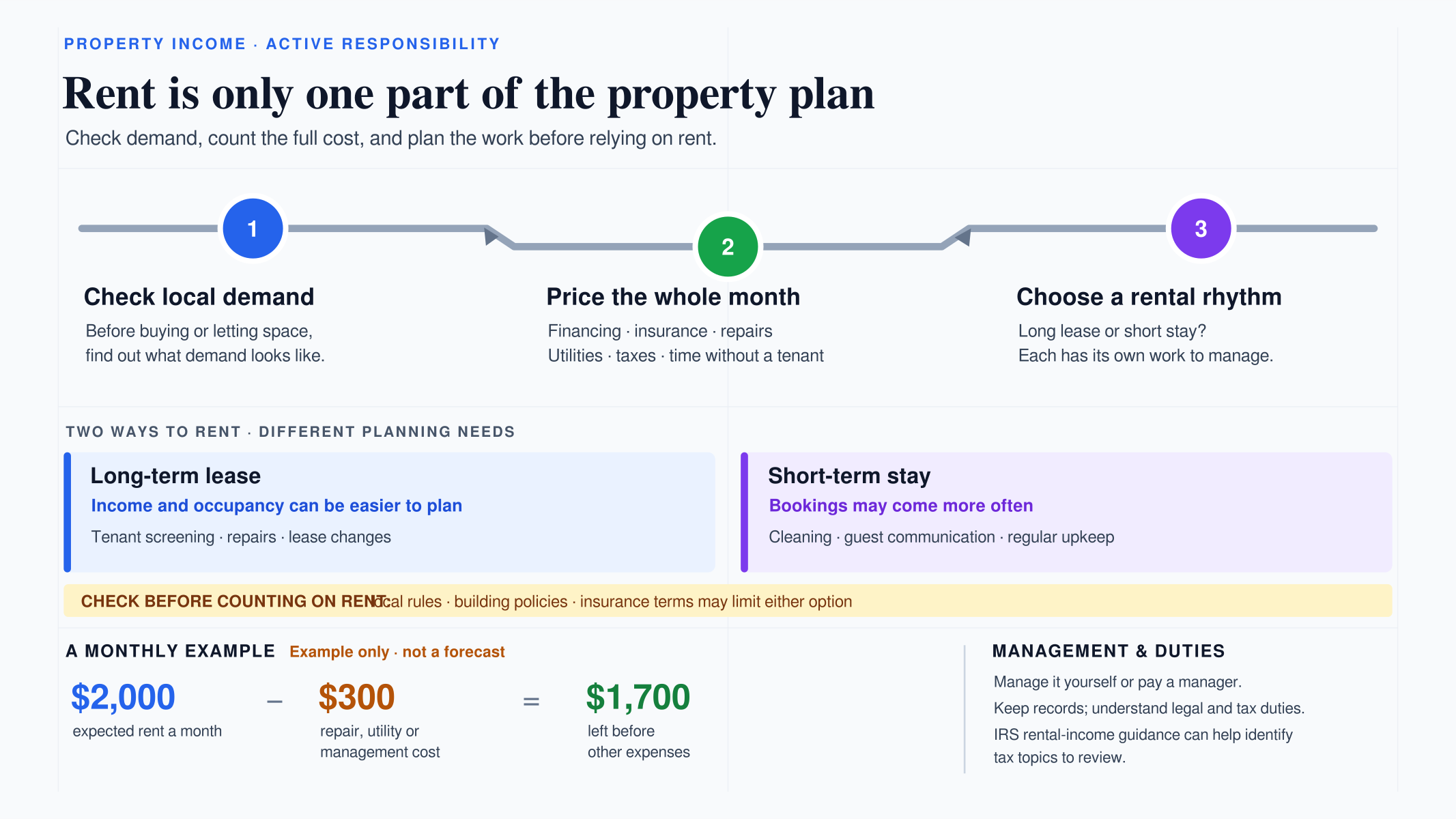
Renting out a home, apartment, or spare room can bring in recurring payments, but owning a rental is an active responsibility. Before you buy or rent out space, check local demand and estimate the full cost of operating the property. Include financing, insurance, repairs, utilities, taxes, and periods without a tenant. A projected rent amount alone won’t tell you whether the property can meet your financial goals.
Compare Long-Term Rentals and Short-Term Stays
Long-term leases can make income and occupancy easier to plan, though you’ll still need to screen tenants, handle repairs, and manage lease changes. Short-term stays may bring more frequent bookings, but they can also require cleaning, guest communication, and regular upkeep. Local rules, building policies, and insurance terms can limit either option, so check them before you count on rental income.
Account for Costs, Vacancies, and Management
Build a realistic monthly estimate that includes a repair reserve and some time without rent. For instance, if expected rent is $2,000 a month, a $300 repair, utility, or management cost would leave $1,700 before other expenses. That’s only an example, not a forecast. You can manage a property yourself or pay a manager, but either way, keep records and understand your legal and tax duties. The [IRS guidance on rental income](https://www.irs.gov/taxtopics/tc414) can help you identify tax topics to review.
3. Use REITs to Invest in Real Estate Without Owning Property

A real estate investment trust, or REIT, lets you invest in a company or fund that owns or finances income-producing real estate. It can offer exposure to property without requiring you to buy a building or find tenants. REITs can focus on different property types, such as apartments, offices, or warehouses, and their performance can vary with property markets and financing conditions.
How REITs Generate Distributions
A REIT may collect rent or earn income from real estate loans, then pay some income to investors as distributions. Payments and share prices can change, and neither is guaranteed. Before investing, read the fund or company information to understand its holdings, fees, debt, and approach. Don’t treat a distribution as a fixed return or assume a property-focused investment can’t lose value.
Choose Between Publicly Traded and Private REITs
Publicly traded REITs are bought and sold on exchanges, so you can generally see market prices and trade through a brokerage account. Private REITs may have different access rules and may be harder to sell or value. Check fees, redemption terms, and investment risks before committing. The [SEC’s investor resources](https://www.investor.gov/introduction-investing/investing-basics/investment-products/real-estate-investment-trusts-reits) explain REIT basics and offer a starting point for your research.
4. Create and Sell Digital Products

If you have useful knowledge or a creative skill, you can package it as a digital product. Examples include a workbook, design template, short course, or practical guide. Start with a specific problem you can help solve, then check whether people are looking for a solution before you spend weeks creating one. A small first version can help you learn what buyers value.
Turn Useful Knowledge Into a Product
Choose one audience and one clear outcome. For example, if you’re comfortable with household budgeting, you might create a simple monthly planner that helps someone sort bills and savings goals. Keep the product focused and easy to use. Ask a few likely users to try it and point out confusing instructions before you offer it more widely.
A digital product can keep selling after you create it, but lasting value depends on solving a real problem and keeping the product useful.
Build a Simple Sales and Delivery System
Choose a platform that can take payment and deliver the file or lesson, then check its fees, refund rules, and customer support tools. Write a clear description that explains what’s included and what buyers will need. For a product priced at $20, 10 sales would mean $200 in gross revenue before platform fees, taxes, and refunds. Plan time to answer questions and update the material when needed. [Coursera’s overview](https://www.coursera.org/articles/passive-income) includes digital business ideas alongside investment-based approaches.
5. Collect Royalties From Creative Work

Royalties can pay you when someone uses creative work you own or have permission to license. You might publish a book, license photographs, distribute music, or make a design available for commercial use. The work may keep earning after its creation, but income can be uneven and depends on demand, rights, and platform terms. Think of royalties as a possible income stream, not a guaranteed paycheck.
Explore Books, Music, Photography, and Licensing
Pick a format that fits your skills and the audience you want to reach. A photographer might license images through a stock platform, while a writer could publish a guide for a narrow interest. Before producing a large collection, test interest with a sample or small release. Keep track of where your work appears and whether each use matches the audience and rights you intended.
Understand Rights, Platforms, and Payout Terms
Read the contract before uploading or licensing anything. Check who owns the work, how long the agreement lasts, which regions it covers, what share you receive, and when you’ll be paid. Confirm whether the platform can grant rights to others and how you can remove your work. Keep copies of agreements and original files. If a contract is unclear, consider getting qualified legal advice before you sign.
6. Earn Interest From Savings and Bonds
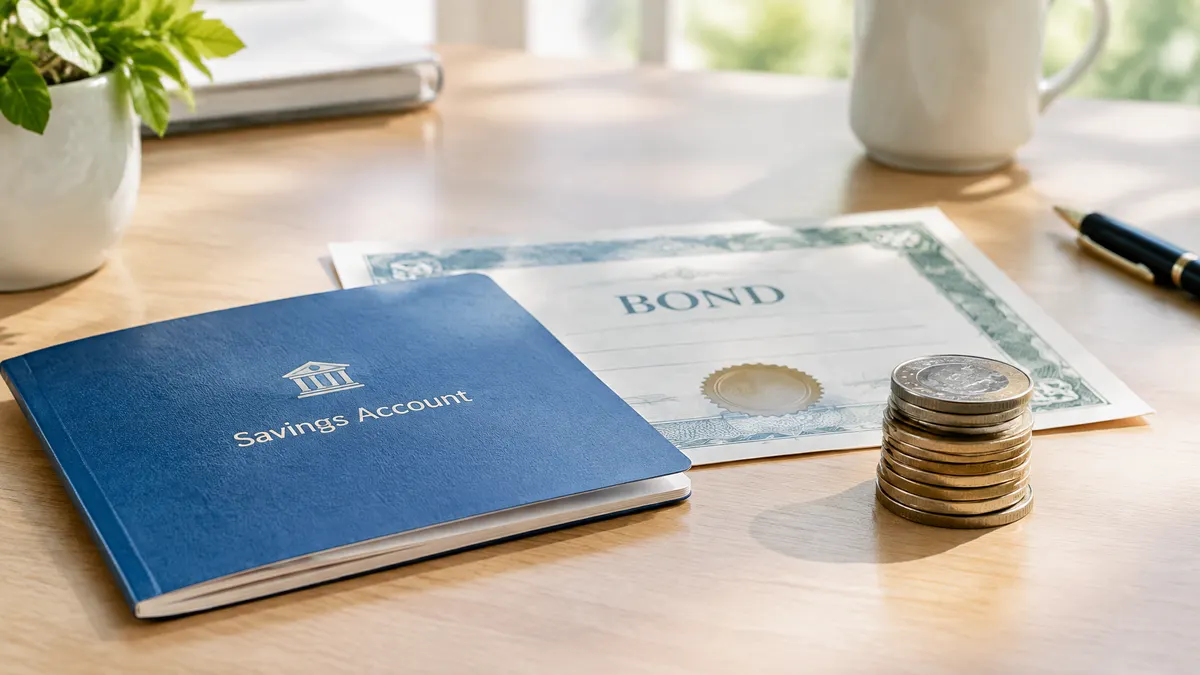
Savings accounts and bonds can generate interest without requiring you to manage a property or create a product. They can suit different needs, so compare access to your money, the issuer, account protections, fees, and the possibility of price changes. Interest rates can change over time, and a fixed payment doesn’t remove every risk. Your choice should fit the purpose of the money, not just the advertised return.
Compare High-Yield Savings Accounts and Bonds
A high-yield savings account usually gives you easier access to your cash, while a bond generally pays interest under set terms and may be harder to sell at a favorable price before maturity. Rates and rules vary, so check the details with the provider. As a simple illustration, $5,000 earning 3% over a year would produce about $150 in interest before taxes if that rate stayed constant. That example isn’t a current-rate promise.
Match Interest-Bearing Assets to Your Time Horizon
Keep emergency savings accessible rather than placing every dollar in an investment with withdrawal limits or potential price swings. For money you won’t need soon, compare bond terms and consider what could happen if you sell early. You can also spread savings across suitable options instead of relying on one account or issuer. The right balance depends on your goals, need for cash, and comfort with risk.
7. Build Affiliate Income With Evergreen Content
Affiliate income comes from recommending a product or service through a trackable link and receiving a commission when a reader takes a qualifying action. To build a useful long-term resource, choose a topic you understand and focus on questions people are likely to keep asking. The income may take time to develop, and search traffic, platform rules, and commission terms can change.
Create Helpful Content Around Long-Lasting Needs
Write practical articles, guides, or tutorials that help readers compare options or complete a task. A guide to choosing a basic home tool, for example, can remain useful if you explain what features matter instead of tying the whole article to a short-lived trend. Give readers clear criteria and disclose what a product can’t do. [Meriwest’s overview](https://www.meriwest.com/our-story/blog/8-side-hustles-build-passive-income-2026) also describes affiliate marketing among possible income ideas.
Maintain Trust, Disclosures, and Updated Recommendations
Tell readers clearly when a link may earn you a commission, and don’t recommend something only because it pays. Check product details and links on a regular schedule, especially when prices, features, or availability may have changed. Keep your evaluation fair by explaining who a product suits and who may want another option. The [FTC’s endorsement guidance](https://www.ftc.gov/business-guidance/resources/disclosures-101-social-media-influencers) explains disclosure expectations for endorsements and affiliate relationships.
Conclusion
Building income that lasts starts with choosing an approach you can support, not chasing the most impressive-sounding return. Dividend investments, rentals, REITs, digital products, royalties, interest, and affiliate content each ask for different resources. Some need savings upfront; others need time, specialist knowledge, or ongoing attention. Passive earning is usually a process of setting up an asset, checking how it performs, and maintaining it when circumstances change.
Choose one option and write down your goal, starting costs, likely risks, and the work you’ll need to do each month. Then test your assumptions with a modest first step, such as researching a fund’s fees, estimating a rental’s expenses, or sharing a product draft with potential customers. Track actual income after costs, not just sales or headline payments. If the numbers or workload don’t suit you, adjust before expanding.
Over time, you may decide to add another income source, but you don’t need to begin with several. Keep emergency savings and essential goals in view, and get qualified financial, tax, or legal help when a decision calls for it. A steady plan built around clear fundamentals can help you make better choices and give your future income streams room to grow.
Frequently Asked Questions
Frequently Asked Questions
How much money do I need to start earning passive income?
How can I choose a passive income idea that fits my situation?
How long does it take for a passive income stream to start paying?
Do I need to pay taxes on passive income?
How can I tell whether a passive income opportunity is legitimate?
Should I pay off debt before trying to build passive income?
How can I tell whether a passive income stream is actually profitable?
When should I reinvest passive income instead of spending it?
Sources
- Passive income ideas 2026 | U.S. Bank
https://www.usbank.com/financial-education/save/passive-income.htmlU.S. Bank outlines passive income streams, including interest-bearing accounts and royalties.
- 15 Passive Income Ideas to Help You Generate Cash Flow
https://www.navyfederal.org/makingcents/investing/15-passive-income-idea-to-generate-cash-flow.htmlNavy Federal presents 15 passive income ideas focused on generating cash flow.
- 11 Passive Income Ideas to Increase Your Cash Flow in 2026
https://www.coursera.org/articles/passive-incomeCoursera lists 11 passive income ideas aimed at increasing cash flow in 2026.
- How to make passive income – Fidelity Investments
https://www.fidelity.com/learning-center/smart-money/passive-income-ideasFidelity explains ways to make passive income and describes it as regular cash flow that requires little time or effort to maintain.
- 8 Side Hustles to Build Passive Income in 2026
https://www.meriwest.com/our-story/blog/8-side-hustles-build-passive-income-2026Meriwest describes eight side hustles for building passive income in 2026.
- Passive Income – Reddit
https://www.reddit.com/r/passive_incomeReddit’s r/passive_income community is a forum for sharing passive-income experiences, evaluating ideas, and learning from others.
- I tracked every “passive income” idea I tried over 2 years … – Reddit
https://www.reddit.com/r/passive_income/comments/1s92wwq/i_tracked_every_passive_income_idea_i_tried_overA Reddit post describes tracking passive-income ideas tried over two years.
- The Smart Passive Income Online Business and Blogging Podcast
https://podcasts.apple.com/us/podcast/the-smart-passive-income-online-business-and/id383084001The Smart Passive Income podcast explores creating multiple income streams to support more time and freedom for activities you enjoy.