Introduction
Passive income isn’t money that arrives without effort; it’s income you work to set up so it can continue with less daily attention. If you want to earn passive income, you’ll need to choose a suitable asset or business idea, put in time or money upfront, and plan for ongoing costs and risks. That could mean investing in dividend-paying companies, creating a digital product, or licensing work you already own. Each path works differently, so the best starting point depends on your skills, available funds, and willingness to manage uncertainty.
Before you begin, check your budget, pay attention to high-interest debt, and decide how much time you can give this project each week. You don’t need to pursue all seven ideas. Choose one that fits your circumstances, learn how its income and risks work, and start with a manageable commitment. Passive income is usually more accurately described as income that may require less ongoing labor after the setup stage.
Before you begin: Gather a basic budget, a record of your available time, and any relevant account or creative-work details. For investment ideas, you’ll also want to understand your own tolerance for losing money. For business ideas, identify the problem you can solve and the people who might pay for that solution. The steps below will help you compare options and take a sensible first action.
Key Takeaways
- Passive income still takes work: These income streams usually require upfront time or money and may need ongoing promotion, updates, customer support, or risk management.
- Choose an idea that fits your situation: Compare your skills, available funds, time, and tolerance for uncertainty; start with one manageable option and account for your budget and high-interest debt.
- Investment income is not guaranteed: Dividends and REIT distributions can change, and share prices can fall. Review fees, debt, holdings, and risks rather than relying on a high yield or recent payout.
- Build products around a real need: Digital products and print-on-demand designs are more useful when they serve a clearly defined audience. Test the buyer experience, check costs, and use materials you have permission to use.
- Trust matters when earning through recommendations: Affiliate content should help people make informed choices, explain drawbacks, and clearly disclose commission relationships. Building an audience takes time, and platforms can change.
1. Build a Dividend Portfolio to Earn Passive Income

How Dividend Investing Generates Income
When a company distributes part of its earnings to shareholders, you may receive cash dividends based on the shares you own. You can keep that money as income or reinvest it to buy more shares. Payments aren’t guaranteed, though: a company can reduce or stop its dividend, and its share price can fall. That means a dividend isn’t the same as interest from a guaranteed deposit. Learn the basics of risk and investment choices through the [SEC’s investor education resources](https://www.investor.gov/introduction-investing).
Use this checklist to assess dividend investments before relying on them for income.
| What to review | What to look for | Why it matters |
|---|---|---|
| Dividend history | Check whether the company has maintained, increased, reduced, or suspended its payments. | Past payments provide context, but they do not guarantee future dividends. |
| Business and financial health | Review the company’s earnings, cash flow, debt, and ability to fund its dividend. | A payment may be harder to sustain if the business cannot support it. |
| Portfolio concentration | Consider how much of your portfolio depends on one company or industry. | Spreading investments can reduce exposure to problems at a single company or across one sector. |
| Your use for the payments | Decide whether to take dividends as cash or reinvest them in additional shares. | Your choice affects how you use the income and how your investment may grow over time. |
| Investment risks | Review the possibility of dividend cuts, share-price declines, and investment losses. | Dividend income is not guaranteed, and you may lose money on the shares you own. |
Getting Started and Managing Investment Risk
First, set a contribution amount that won’t interfere with bills, emergency savings, or debt payments. Then compare diversified funds and individual companies by looking at their holdings, fees, business stability, and dividend policies. Don’t choose an investment simply because its advertised yield looks high; a high yield can reflect a falling share price or financial trouble. Spread your money across investments and review your plan periodically, rather than reacting to each market move. Consider tax rules and account fees before investing.
- Write down your goal and the amount you can afford to invest regularly.
- Read the fund or company information before you buy.
2. Invest in Real Estate Through REITs

How REITs Pay Income Without Direct Property Management
A real estate investment trust, or REIT, lets you invest in a company that owns or finances income-producing real estate. Depending on its structure, a REIT may hold apartments, offices, warehouses, or other property. You can buy shares in some publicly traded REITs through a brokerage account, so you don’t need to find tenants or arrange repairs yourself. REITs may pay distributions, but amounts can change and share prices can decline. Read the [SEC’s REIT investor bulletin](https://www.investor.gov/introduction-investing/investing-basics/investment-products/real-estate-investment-trusts-reits) to understand common types and risks.
Choosing a REIT and Understanding the Risks
Compare what a REIT owns, how it earns money, its debt, management costs, and distribution history. Publicly traded REITs can be bought and sold on exchanges, while non-traded products may be harder to sell and may have different fees. Don’t assume every REIT offers the same access or risk. Interest rates, property vacancies, tenant problems, and changing demand can all affect results. Before you invest, check how the product is registered and whether you can access your money when needed. Keep your REIT holdings in proportion to your broader investment plan.
- Check whether the REIT is publicly traded and review its fees.
- Look at property types and debt, not just its recent distribution.
3. Create and Sell Digital Products
Digital Product Ideas That Solve Specific Problems
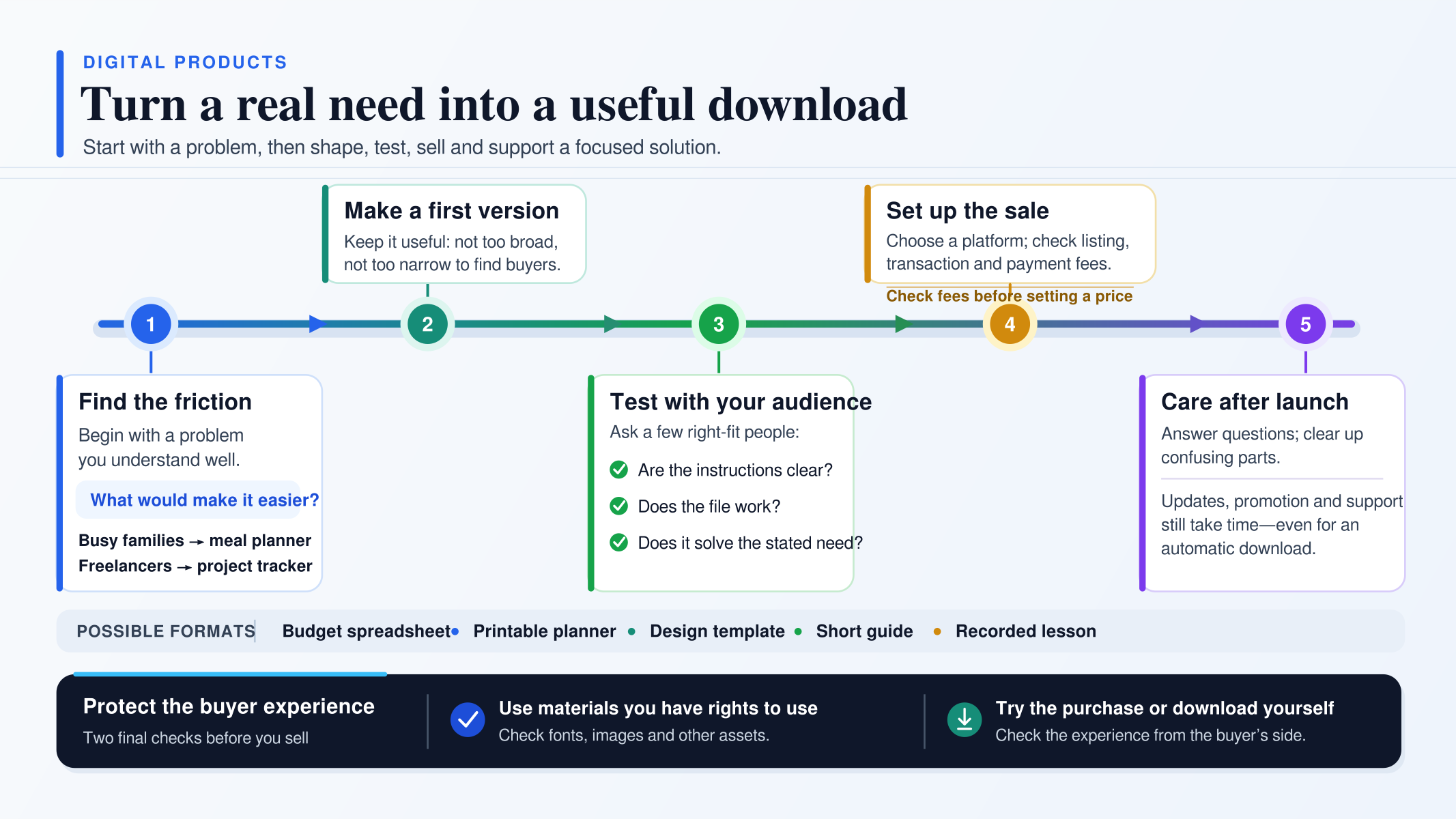
A digital product can be a budget spreadsheet, printable planner, design template, short guide, or recorded lesson. Start with a problem you understand well, then ask what would make it easier for someone to solve. A meal planner for busy families, for example, needs a different format from a project tracker for freelance designers. Make the product specific enough to be useful, but not so narrow that you can’t find potential buyers. You can explore examples of digital products in [Meriwest’s overview of passive-income ideas](https://www.meriwest.com/our-story/blog/8-side-hustles-build-passive-income-2026).
Building, Pricing, and Selling Your First Product
Create a simple first version and test it with a few people who fit your audience. Ask whether the instructions are clear, the file works, and the product solves the stated problem. Then choose a selling platform and check its listing, transaction, and payment fees before setting a price. Your sales page should explain what buyers receive, who it’s for, and any limits. After launch, answer customer questions and fix confusing parts. A digital download may be delivered automatically, but updates, promotion, and support can still take time.
- Confirm that your fonts, images, and other materials are yours to use.
- Make a test purchase or download so you can check the buyer’s experience.
4. Earn Affiliate Income From Useful Recommendations

Choose a Niche and Build an Audience
Affiliate income comes from recommending a product or service through a tracked link; you may receive a commission if someone makes a qualifying purchase. To build a useful channel, focus on a subject you can cover accurately, such as home cooking tools, software for freelancers, or beginner fitness gear. Publish practical comparisons, tutorials, or answers to common questions on a blog, newsletter, or video channel. You’ll need to earn attention before links can generate meaningful income, and search or social platforms can change how they show your content.
Your recommendation is only useful when it helps someone make a better-informed choice. Put the reader’s needs first, explain trade-offs plainly, and recommend a product only when it fits the situation you describe.
Create Trustworthy Content and Disclose Links
Choose products you can assess honestly, and explain what you know firsthand versus what you’ve learned from product details. Include drawbacks and relevant alternatives instead of presenting every option as perfect. Make your affiliate relationship clear near the recommendation, where readers can notice it before they click. The [FTC’s endorsement guidance](https://www.ftc.gov/business-guidance/resources/ftcs-endorsement-guides-what-people-are-asking) explains how to disclose material connections. Review program terms, commission rules, and link restrictions, then update older content when products or terms change. Audience trust matters more than adding a link to every paragraph.
5. Launch a Print-on-Demand Store

Design Products for a Clearly Defined Audience
With print-on-demand, a supplier prints and ships an item after a customer orders it. You can test designs on products such as shirts, mugs, or posters without storing inventory at home. Start by choosing a clear audience and a design that speaks to its interests, rather than uploading generic slogans. Check that your artwork is readable at the product size and that you have permission to use every image, phrase, or font. Order a sample when practical so you can inspect the material, print quality, and packaging before promoting it.
Compare Platforms, Costs, and Fulfillment Options
Compare marketplaces and independent storefronts by their fees, audience reach, product choices, shipping options, and rules. Work out the full cost of each sale, including production, platform charges, payment processing, and any promotion. Set a price that leaves room for those costs while remaining reasonable for your target buyer. A fulfillment partner may handle printing and shipping, but you’re still responsible for customer service, product listings, and quality issues. Read platform terms before you launch, and keep records of orders and expenses. The [U.S. Small Business Administration’s business planning guidance](https://www.sba.gov/business-guide/plan-your-business) can help you think through the basic costs and operating plan.
6. License Your Photography, Music, or Writing

Prepare Creative Work for Licensing
Licensing lets another person or business use your work under agreed terms while you retain rights, depending on the license. Prepare clean, high-quality files and organize them with accurate titles, descriptions, and searchable tags. For photos, check that you have permission for recognizable people, private property, and any protected artwork shown. For music, keep track of who contributed to the recording and composition. For writing, clarify whether you’re licensing an article, a template, or another specific work. Review the [U.S. Copyright Office’s copyright basics](https://www.copyright.gov/what-is-copyright/) to learn about copyright ownership and protection.
Choose Licensing Channels and Protect Your Rights
Compare stock libraries, licensing marketplaces, and direct deals by their audience, fees, exclusivity rules, payment terms, and allowed uses. Read each agreement carefully: an exclusive license may limit where else you can offer the same work, while a broader license may grant more uses than you intend. Keep original files and dated records, and save copies of contracts and permissions. Don’t upload material you don’t own or have permission to license. A marketplace can bring potential buyers, but it doesn’t guarantee that your work will sell. Review licenses as your portfolio grows and update descriptions if rights or permissions change.
7. Earn Interest Through Peer-to-Peer Lending
How Peer-to-Peer Lending Platforms Work
Peer-to-peer lending platforms connect people seeking loans with investors who provide funding, sometimes by splitting loans into smaller portions. If borrowers make payments, you may receive principal and interest according to the platform’s terms. But the expected return isn’t guaranteed, and you can lose some or all of your money if borrowers don’t repay. Platform features, borrower screening, and investor protections vary, and a platform’s closure could create extra complications. Review the loan agreement, payment process, and withdrawal rules before you deposit funds.
Assess Defaults, Platform Fees, and Diversification
Read how the platform assesses borrowers, handles missed payments, charges fees, and collects overdue debt. Look for clear information about loan terms and what happens if the platform stops operating. Don’t invest money you’ll need soon, and avoid concentrating your funds in one borrower or loan type. Diversification can reduce the effect of one missed payment, but it can’t remove the risk of widespread defaults or platform problems. Compare the possible return after fees with the possibility of delayed payments and loss. For broader context, review [FINRA’s investor information](https://www.finra.org/investors) and seek local, qualified advice if you’re unsure whether this approach fits your plan.
Conclusion
You can earn passive income through investments, creative work, or a small online business, but each path asks for something upfront. That might be savings, research, a useful product, or a portfolio of work. Even after setup, you may need to monitor investments, answer customers, update content, or review platform terms. Treat projected income as uncertain, and build your plan around the risks and ongoing tasks you can realistically manage.
To get started, choose one idea that matches your resources and write down its first practical action. You might compare diversified investment options, test a digital download with potential buyers, or prepare a small group of photographs for licensing. Set a modest limit for your time or money, check fees and rules, and review what you learn before expanding. This measured approach helps you build experience without assuming every idea will produce the same results.
Your next step is to turn that choice into a simple plan: what you’ll do, what it may cost, how you’ll track progress, and when you’ll reassess. Start small, protect your essential finances and creative rights, and adjust based on real results. A reliable income stream takes thoughtful choices and ongoing attention, not a promise of effortless returns.
Frequently Asked Questions
Frequently Asked Questions
Is passive income taxable?
How can I spot a passive income scam?
How much ongoing work does passive income usually require?
Should I reinvest passive income or spend it?
Can passive income replace a full-time salary?
How do I choose a passive income idea that fits my budget and schedule?
What records should I keep for passive income?
What should I do if a passive income stream stops paying?
Sources
- 15 Passive Income Ideas to Help You Generate Cash Flow
https://www.navyfederal.org/makingcents/investing/15-passive-income-idea-to-generate-cash-flow.htmlNavy Federal presents 15 passive income ideas for generating cash flow.
- Passive income ideas 2026 | U.S. Bank
https://www.usbank.com/financial-education/save/passive-income.htmlU.S. Bank explains passive income as earnings that do not require daily labor, though they may involve upfront effort or oversight, and presents passive income ideas.
- 11 Passive Income Ideas to Increase Your Cash Flow in 2026
https://www.coursera.org/articles/passive-incomeCoursera presents 11 passive income ideas to increase cash flow in 2026.
- 8 Side Hustles to Build Passive Income in 2026
https://www.meriwest.com/our-story/blog/8-side-hustles-build-passive-income-2026Meriwest outlines eight side hustles for building passive income in 2026.
- How to earn passive income based on assets you already own – AIA
https://www.aia.com/en/health-wellness/healthy-living/healthy-finances/Passive-income-ideasAIA discusses ways to earn passive income from assets you already own.
- Passive Income – Reddit
https://www.reddit.com/r/passive_incomeReddit’s r/passive_income community is a forum for sharing passive-income experiences, evaluating ideas, and learning from others.
- I tracked every “passive income” idea I tried over 2 years … – Reddit
https://www.reddit.com/r/passive_income/comments/1s92wwq/i_tracked_every_passive_income_idea_i_tried_overA Reddit post about tracking passive-income ideas tried over two years.