
EliteIsle.com - The Pinnacle of Prestigious Living
No Result
View All Result
Monday, November 2, 2026
  • Login
  • Register
  • Home
  • Health
  • Wealth
  • Business
  • LifeStyle
  • Tech
  • World & Travel
Subscribe
EliteIsle.com - The Pinnacle of Prestigious Living
  • Home
  • Health
  • Wealth
  • Business
  • LifeStyle
  • Tech
  • World & Travel
No Result
View All Result
EliteIsle.com - The Pinnacle of Prestigious Living
No Result
View All Result
Home Health

The Great Divide: What the Wealthy Protect (Time, Attention, and Recovery)

by Elite Isle
July 6, 2026
in Health
Reading Time: 10 mins read
224 7
0
185
SHARES
2.3k
VIEWS
Share on FacebookShare on TwitterShare on PinterestShare on Reddit

Introduction

Imagine it’s Tuesday morning, you’re halfway through your most important project, and a “quick question” turns into three meetings, five new tasks, and an inbox refresh you didn’t plan. That’s a common time tax. If you’ve ever felt like your calendar is driving your day instead of you driving it, you’re not alone. The advantage the wealthy protect is rarely just more hours. It’s time protection, the habit of keeping your attention and energy available for the work that actually moves the needle.

Here’s the key link. Attention is what you spend on tasks, and recovery is what replenishes the ability to focus again tomorrow. When attention leaks too much and recovery gets shorted, even talented people burn out and end up reacting. Wealth often comes from doing fewer high-value things well, repeatedly, over time. Time protection is the foundation that makes that repetition possible.

Key Takeaways

  • Time protection is a system: preserve attention for high-value work and ensure recovery replenishes your ability to focus later.
  • The wealthy plan for interruptions and set clear reachability rules, turning “availability” into a managed resource to cut surprise obligations.
  • A proactive calendar creates an “allocation advantage,” letting you choose key work blocks instead of reacting to requests as they arrive.
  • Protect deep work by batching messages, setting repeatable boundaries, and cutting low-value tasks that don’t break if you delay them.
  • Sustain output by scheduling recovery (sleep, movement, real downtime); without it you make slower decisions and fall behind.

Time Protection as a System, Not a Personality Trait

People like to assume time protection is a “discipline” trait, like you either have it or you don’t. In real life, the difference is usually design. The wealthy tend to build days that prevent depletion, so work and life don’t keep stealing from the same limited resource. They also assume interruptions will happen, so they plan around them instead of pretending they can control everything.

Time protection isn’t a personal virtue you either have or don’t – it’s a design choice. The wealthy reduce depletion by building availability rules into their schedule, so interruptions become expected inputs instead of surprise demands.

Turning availability into a managed resource is a simple shift. You decide when you’re reachable, when you’re not, and what kind of requests you accept. Then you reinforce it with clear scheduling and consistent rules. That means fewer surprise obligations, less decision fatigue, and more protected time for deep work. A system also helps you stay consistent on busy weeks, not just when motivation is high.

The Allocation Gap: Who Chooses, Who Reacts

Source: example.com. Split-screen photographic divide showing a wealthy city skyline versus a poorer rural landscape, overlaid with a subtle clock/time motif symbolizing time protection and global allocation gaps
A photographic split-scene illustrating time protection and the Great Divide behind global allocation gaps.

There’s often a hidden gap between people who choose their day and people who react to whoever asks first. Proactive calendars put key work blocks on the schedule before the day starts. Reactive schedules fill up only when messages arrive, which makes urgent requests feel like emergencies even when they’re not. Over time, that gap changes what gets done, and it changes how confident you feel using your time.

Delegation can protect decision-making, not just offload tasks. When you delegate properly, you remove repeated approvals and reduce the number of choices you have to make. You stay responsible for the direction, but you stop being the bottleneck for everything small. A useful rule is to delegate anything that doesn’t require your unique judgment, and keep only what truly benefits from your specific expertise. That’s how time protection becomes practical.

Attention Insurance: Defending Deep Work and Focus

Source: sciencedirect.com. Person at a desk wearing a smartwatch and holding a calendar or planner, with a subtle light-vs-shadow split-screen metaphor showing protected time and attention “insurance” across two timeline
Defending attention and protecting time with clear boundaries

Deep work is hard to maintain when interruptions keep breaking your mental thread. Reducing interruptions with boundaries and batching helps you keep focus long enough to finish meaningful chunks. For example, instead of checking messages constantly, you can batch reviews into two or three windows, and you can set expectations for response times. Boundaries work best when they’re simple and repeatable, so people know what to do without asking you.

Then choose high-leverage tasks over low-value busywork. A quick way to spot busywork is to ask, “If I skip this for a week, does anything break?” If the answer is no, it’s a strong candidate to move, reduce, or drop. Environment design matters too, cues that support focus like a tidy workspace, a consistent “start” ritual, or tools that block distractions during work blocks. As one common mantra goes, “Protect the conditions, and the work becomes easier.”

  • Batch messages into set windows, not throughout the day.
  • Use a “start ritual” so focus begins on cue.
  • Cut low-value tasks by asking what breaks if you delay.

The Recovery Dividend: Protecting Energy to Sustain Output

Even perfect scheduling can fail if you can’t recover. Sleep, movement, and downtime prevent time debt, which is the gap that builds when you work while running on depleted energy. When recovery is missing, you don’t just feel tired, you also make slower decisions and need more time to do the same work. That’s why people with “good intentions” often still fall behind.

Scheduling rest like a fixed commitment is the turn that changes everything. You treat rest blocks the same way you treat work blocks, because your brain and body need planned downtime to keep output consistent. Movement doesn’t have to be intense, a short walk can help you reset attention. Downtime also includes doing nothing on purpose, like a real break away from screens, not just switching tabs.

Recovery lever What it protects Simple example
Sleep Focus, memory, decision quality Keep a consistent bedtime, even on hectic days
Movement Energy and mental clarity 10 to 20 minutes of walking between work blocks
Downtime Stress load and attention recovery No work tasks during lunch, phone stays away

Infrastructure for Time: Help, Tools, and Trusted Delegation
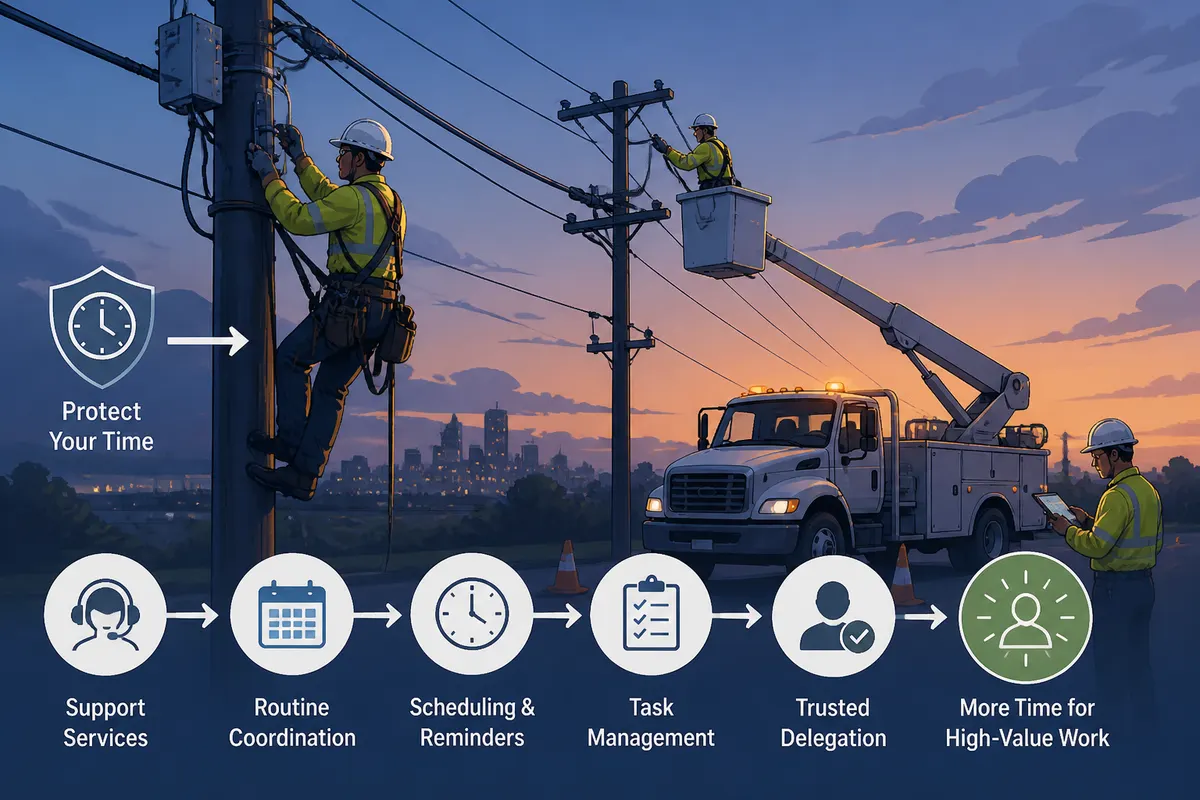
Workers in safety gear maintain a power and communication network at dusk, repairing cables on utility poles and symbolizing time protection by keeping critical infrastructure connected at night.
Teams protect essential infrastructure – keeping critical systems running across the “great divide.”

Time protection gets easier when you buy leverage with support services and specialists. That doesn’t mean outsourcing everything. It means paying to remove friction so you stop spending your best hours on repetitive chores. For many people, the biggest gains come from support that handles routine coordination, scheduling, admin, or research. When those steps are handled well, you spend your time on decisions that truly require your judgment.

Systems and automation also remove repeated decisions. Instead of choosing from scratch every time, you create defaults, templates, and rules. A simple example is a “request form” or a clear intake process that directs how people ask for help. Another is automation that turns recurring tasks into scheduled actions, so you don’t rely on memory and willpower. Trusted delegation is the final piece, you delegate outcomes with clear standards, so quality stays high while your decision load drops.

  • Use specialists for recurring friction, not for urgent heroics.
  • Create templates and defaults to reduce repeat decisions.
  • Delegate with clear standards, so you don’t re-review everything.

Closing the Divide: Practical Ways to Protect Time Today

Rugged mountain pass landscape on the Great Divide with a split road, dramatic “Protected Corridor” safety signage and closing barriers under moody light
A dramatic view of the Great Divide with a marked protected route – symbolizing practical protection and the closing of unsafe gaps.

You don’t need a perfect routine to start. Start by auditing your calendar for attention leaks and reactive traps. Look at what you keep doing, then flag what’s pulling you away from deep work. Common leaks include meetings with no clear owner, task lists that grow but never finish, and “open loops” created by unclear next steps. When you spot patterns, you can redesign your workflow instead of just trying harder.

Set boundaries that make “no” and “not now” easier. It helps to use consistent language and clear alternatives, like offering a different time window or suggesting a smaller initial step. Then build recovery routines that keep output sustainable, like a short reset after your busiest block and a daily shutdown step that protects tomorrow. Here’s a quick checklist you can run this week:

  • Block one protected focus session, at the same time each week if possible.
  • Batch messages into two windows, and turn off non-urgent notifications.
  • Pick one task to delay or delegate, based on whether anything breaks.
  • Schedule a recovery block, even if it’s just a planned walk and no work.

Conclusion

The great divide isn’t magic time management. It’s protection that’s built into daily systems. When you protect attention first, you give deep work a chance to happen. When you protect recovery next, you make sure your focus stays available tomorrow. That combination helps you stop the cycle of urgent reactions and start doing fewer, better things consistently.

Your next step is simple: protect attention, then protect recovery. Pick one focus block to guard this week, set one clear boundary for interruptions, and schedule one rest block you won’t negotiate away. After that, review what changed, and adjust the system instead of blaming yourself. Over time, time protection becomes a measurable advantage, because your calendar stops running your life and starts reflecting your priorities.


Frequently Asked Questions

What is time protection and why does it matter?

Time protection is the habit of keeping your attention and energy available for the work that truly moves the needle. It matters because without it, interruptions and constant task switching drain your focus (“attention”), while insufficient downtime limits your ability to recover for the next day (“recovery”). Over time, this leads to burnout and more reactive work.

Is time protection a personality trait or a system I can build?

It’s primarily a system, not a fixed trait. While many people think of time protection as “discipline,” the practical difference usually comes from design: setting up your days so work and life don’t repeatedly steal from the same limited resource, and planning for interruptions rather than pretending they won’t happen.

How do attention and recovery work together in time protection?

Attention is what you spend on tasks; recovery is what replenishes your ability to focus again. Time protection focuses on preventing attention leaks (too many interruptions, context switching, unplanned work) and protecting recovery time so your focus doesn’t degrade over days.

What’s a simple way to decide when I should be reachable?

Treat availability as a managed resource. Pick specific windows when you’re open to messages and meetings, and define other times when you’re focused and not expected to respond immediately. This reduces “quick questions” from multiplying into meetings and new tasks.

How can I plan around interruptions instead of trying to eliminate them?

Assume interruptions will happen and design your schedule accordingly. For example, batch communication, reserve buffer time, and keep your most important work in protected blocks. The goal isn’t to control everything – it’s to prevent interruptions from permanently stealing attention from high-value work.

How does time protection support doing fewer high-value things well over time?

Wealth often comes from repeating fewer high-value activities effectively. Time protection makes repetition possible by reducing depletion: when your attention stays available and recovery is sufficient, you can consistently return to the same important work instead of getting pulled into low-value reactive tasks.

What are practical signs that my attention leaks or recovery is too short?

Common signs include feeling like your calendar runs your day, losing focus frequently due to inbox and “quick questions,” needing increasing effort to start tasks, and feeling drained or burned out faster than usual. If you consistently start the next day with low focus, recovery time is likely being shortened.

What should I do first to start practicing time protection this week?

Start with one design change: create protected focus blocks for your highest-impact work and set clear boundaries for when you’re reachable. Then, add a recovery habit (planned downtime, breaks, or end-of-day shutdown) so attention can replenish for tomorrow. Adjust as you learn which interruptions are most disruptive.

Sources

1.Real time protection disabled on Mac OS endpoint – Discussionsreference
community.sophos.com
2.Real Time Protection Creating Non Compliance : r/Intune – Redditreference
reddit.com
3.HIGH Alert – Real time protection disabled… and Sophos is always …reference
community.sophos.com
4.Protect your environment in real-time during agent runtimereference
learn.microsoft.com
Microsoft documentation on protecting environments in real time during agent runtime.
5.Security Application not Running (Failed) , Real Time protection …reference
forum.kaspersky.com
Tags: Bitcoin
Share74Tweet46Pin17Share

Join the Club Now.
Subscribe to Elite Isle for a free exclusive affluent lifestyle insights and savvy investment strategies.

Unsubscribe

Related Posts

Health

Wealth Habits That Help You Save, Invest, and Grow Your Money

October 10, 2026
2.3k
Health

Habits of wealthy people that can strengthen your financial future

October 10, 2026
2.3k
Health

Passive Earning: 7 Ways to Build Income That Lasts

October 10, 2026
2.3k
Health

How to make passive income with 7 beginner-friendly ideas

October 10, 2026
2.3k
Health

How to Earn Passive Income: 7 Ideas to Start Today

October 10, 2026
2.3k
Health

How to Build a Luxury Travel Budget That Fits Your Plans

October 10, 2026
2.3k
  • Trending
  • Comments
  • Latest
Exercise Recovery

Elevate Your Workout Regime: The Essential Guide to Exercise Recovery

December 28, 2023
Embracing Conscious Tourism: A New Wave of Luxury Travel

Embracing Conscious Tourism: A New Wave of Luxury Travel

December 28, 2023
The Great Divide: How Do the Wealthy Really Live?

The Great Divide: How Do the Wealthy Really Live?

December 28, 2023
Advancing Wellness at Home: Embracing the Tech Wave

Advancing Wellness at Home: Embracing the Tech Wave

December 28, 2023
Embracing Conscious Tourism: A New Wave of Luxury Travel

Embracing Conscious Tourism: A New Wave of Luxury Travel

19
Conscious Luxury Travel: A New Age of Enlightenment

Conscious Luxury Travel: A New Age of Enlightenment

16
Electrifying the Road Ahead: The Surge of Electric Vehicles (EVs) in 2023

Electrifying the Road Ahead: The Surge of Electric Vehicles (EVs) in 2023

14
Soaring to New Heights: The Dawn of Hydrogen-Powered Flights

Soaring to New Heights: The Dawn of Hydrogen-Powered Flights

13
How to Build a Millionaire Mindset and Make Smarter Money Decisions

How to Build a Millionaire Mindset and Make Smarter Money Decisions

October 10, 2026

Wealth Habits That Help You Save, Invest, and Grow Your Money

October 10, 2026

Habits of wealthy people that can strengthen your financial future

October 10, 2026

Passive Earning: 7 Ways to Build Income That Lasts

October 10, 2026

Follow us on Instagram

    The Instagram Access Token is expired, Go to the Customizer > JNews : Social, Like & View > Instagram Feed Setting, to refresh it.
You're not logged into Tiktok, please login here
Facebook Twitter Instagram TikTok Pinterest

Latest Articles

How to Build a Millionaire Mindset and Make Smarter Money Decisions

How to Build a Millionaire Mindset and Make Smarter Money Decisions

October 10, 2026

Wealth Habits That Help You Save, Invest, and Grow Your Money

October 10, 2026

Main Menu

  • Home
  • Health
  • Wealth
  • Business
  • LifeStyle
  • Tech
  • World & Travel

Quick Links

  • About Us
  • Privacy Policy
  • Advertisement
  • Blog Articles
  • Contact Us

Developed by Smartec Web Services © 2023 All Rights Reserved to EliteIsle.com.

Welcome Back!

OR

Login to your account below

Forgotten Password? Sign Up

Create New Account!

OR

Fill the forms bellow to register

*By registering into our website, you agree to the Terms & Conditions and Privacy Policy.
All fields are required. Log In

Retrieve your password

Please enter your username or email address to reset your password.

Log In

Add New Playlist

No Result
View All Result
  • Home
  • Health
  • Wealth
  • Business
  • LifeStyle
  • Tech
  • World & Travel

Developed by Smartec Web Services © 2023 All Rights Reserved to EliteIsle.com.

This website uses cookies. By continuing to use this website you are giving consent to cookies being used. Visit our Privacy and Cookie Policy.
Impact-Site-Verification: beba37e0-4c43-4536-9726-4a00cf91832d