
Introduction
A household that once sold investments to cover surprise bills can make a different choice after building cash reserves, automating retirement contributions, and planning taxes before selling. The change doesn’t come from one clever investment. It comes from steady decisions that keep more of your money working toward your goals. These eight strategies for building financial freedom through consistent fundamentals focus on tax-aware investing, retirement accounts, and thoughtful withdrawals. They’re designed to help you make a practical plan, not chase quick wins. Tax rules vary by location and personal situation, so use the steps as a starting point and check details before acting.
Before you begin: Gather recent account statements, a list of your investment accounts, your savings goals, and an estimate of your tax bracket. Decide how much short-term cash you need before investing money for long-term goals. Keep in mind that tax efficiency supports a sound plan; it doesn’t replace an emergency fund, a suitable mix of investments, or debt management. If you’re unsure how a transaction will affect your taxes, pause and ask a qualified tax professional.
Key Takeaways
- Match investments to account types: Consider holding investments that rarely distribute taxable income in taxable accounts and assets that generate more taxable distributions in tax-advantaged accounts, while keeping your goals, risk tolerance, and account rules in view.
- Choose retirement contributions for your tax picture: Compare traditional and Roth accounts based on your current and expected future tax situation, employer matching, fees, and withdrawal rules; neither option is always the better choice.
- Check fund turnover and distributions: A fund that trades less may distribute fewer taxable capital gains, but turnover alone does not determine your tax bill or whether the fund suits your goals.
- Consider holding periods before selling: Check when you bought an investment and estimate the gain before selling. In the United States, holdings kept for more than one year may qualify for long-term capital gains treatment, depending on your circumstances.
- Harvest losses without losing sight of your plan: Selling an investment at a loss may offset eligible capital gains, but the loss does not erase the investment loss. Check wash-sale rules and make sure the investment decision still fits your plan.
- Rebalance with taxes and risk in mind: Directing new contributions toward underweighted investments or rebalancing inside tax-advantaged accounts may help manage portfolio drift without an immediate taxable sale, while keeping your chosen risk level in view.
1. Choose Tax-Efficient Investing Strategies for Each Account

Match Investments to Taxable and Tax-Advantaged Accounts
Start by listing what you own and where you hold it. A taxable brokerage account may suit investments that rarely distribute taxable income, while a retirement account can hold assets that may generate more taxable distributions. This is called asset location. It’s a way to consider taxes across your accounts, not a reason to buy an investment that doesn’t fit your goals or comfort with risk.
Use this comparison as a starting point for considering where different investments may fit; keep your goals, risk tolerance, and account rules in mind.
| Investment characteristic | Potential account fit | Tax consideration |
|---|---|---|
| Broad stock fund with low turnover | Taxable brokerage account | Lower trading activity may mean fewer capital-gains distributions, though dividends and realized gains can still be taxable. |
| Bond fund that distributes regular taxable income | Tax-deferred retirement account, if available and suitable | Interest distributions generally are not taxed annually inside a tax-deferred account; withdrawals are subject to that account’s rules. |
| Investment with higher expected long-term growth | Roth retirement account, if eligible and appropriate | Qualified withdrawals may be tax-free, but contribution, withdrawal, and eligibility rules apply. |
For example, you might keep a broad, low-turnover stock fund in a taxable account and consider income-producing investments inside a tax-deferred retirement account. The right placement depends on your whole portfolio, account rules, and withdrawal plans. Compare the tax treatment of dividends, interest, and sales before changing positions. The SEC’s investor guide to funds can help you review basic fund features. Make a simple account map, then discuss complex tax effects with a professional.
2. Prioritize Tax-Advantaged Retirement Contributions
Compare Traditional and Roth Account Benefits
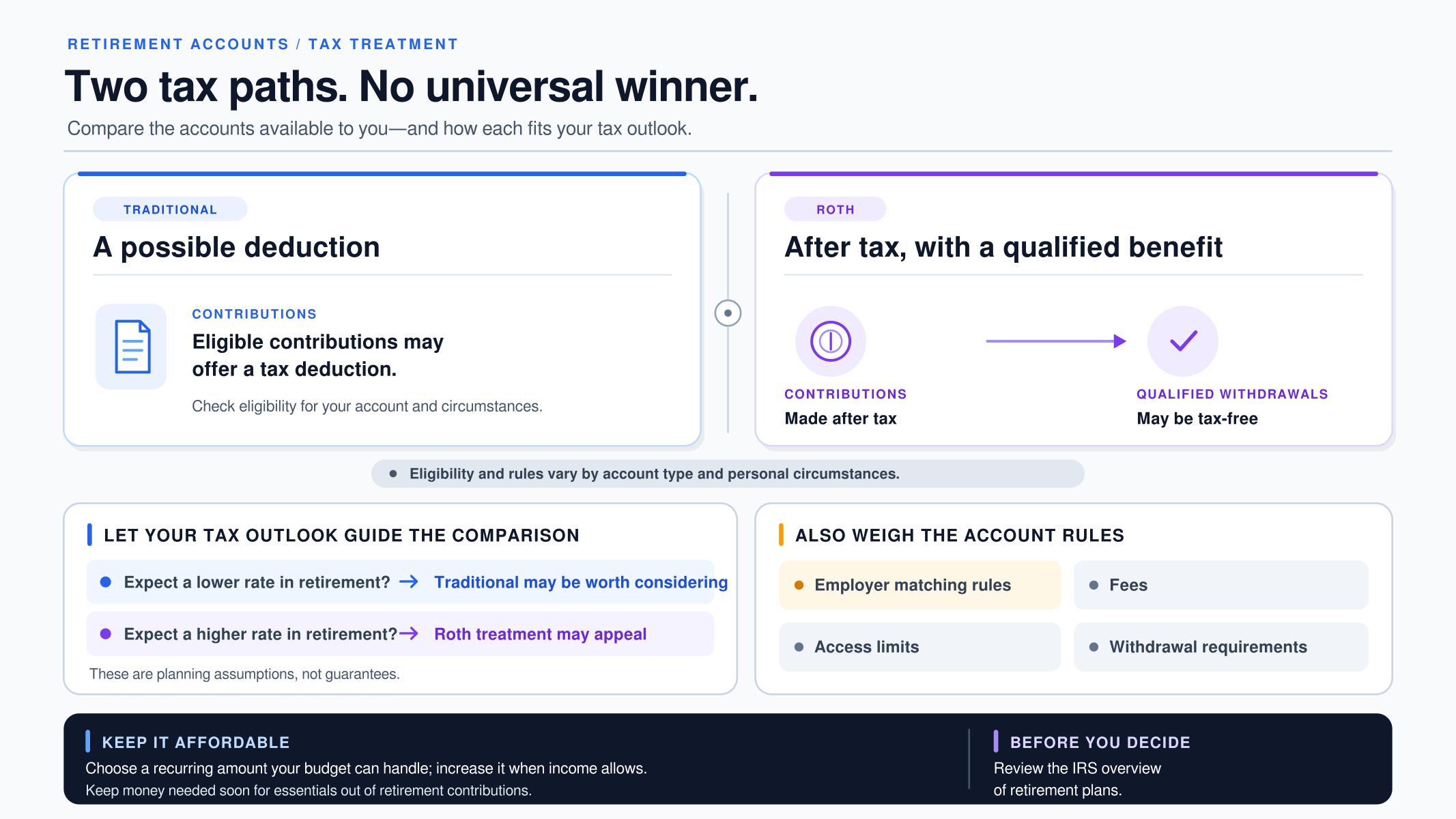
Next, check which workplace and individual retirement accounts are available to you. A traditional account may offer a tax deduction for eligible contributions, while a Roth account generally uses after-tax contributions and may allow qualified withdrawals tax-free. Eligibility and rules depend on the account type and your circumstances. Review the IRS overview of retirement plans before deciding.
Choose based on your current and expected future tax picture, not on a guess that one option always wins. If you expect your tax rate to be lower in retirement, a traditional contribution may be worth considering; if you expect it to be higher, Roth treatment may appeal. Those are planning assumptions, not guarantees. Compare employer matching rules, fees, access limits, and withdrawal requirements too. If your budget is tight, start with an affordable recurring amount and increase it when your income allows. Don’t contribute money you may need soon for essentials.
3. Use Low-Turnover Funds to Limit Taxable Distributions

Understand How Fund Turnover Can Affect Your Tax Bill
Review a fund’s turnover and distribution history before buying it in a taxable account. When a fund sells holdings, it may distribute taxable capital gains to investors, even if you didn’t sell your own shares. Turnover alone doesn’t tell you exactly what you’ll owe, but it can help you ask better questions. Index funds and some exchange-traded funds often trade less than actively managed funds, though fund design and market conditions matter.
Look at the fund’s prospectus, fees, investment approach, and tax information together. A fund with lower turnover isn’t automatically the best choice if it doesn’t match your goals or adds risk you don’t want. For instance, a hypothetical $10,000 taxable investment that distributes $200 in taxable gains could create a tax bill even when you reinvest that distribution. The amount owed depends on your tax situation. Check distribution notices and avoid buying just before a scheduled payout without understanding the consequences.
4. Hold Investments Long Enough to Seek Lower Capital Gains Rates

Plan Sales Around Holding Periods and Tax Brackets
Before selling an investment in a taxable account, check when you bought it and whether the sale would create a gain or loss. In the United States, investments held for more than one year may qualify for long-term capital gains treatment; shorter holding periods are generally treated differently. Tax rates and eligibility depend on your situation. Review the IRS guidance on capital gains and losses before making a significant sale.
Then consider how the sale fits with your income for the year. Selling a large holding all at once could have different tax effects from spreading sales across tax years, but markets can move while you wait. Don’t hold an unsuitable investment solely for a possible tax benefit. Write down why you’re selling, estimate the gain, and check whether you can meet your portfolio goal with a smaller sale. A tax professional can help you compare options when a sale involves a large gain or a complicated return.
5. Harvest Investment Losses Carefully

Offset Gains While Avoiding Wash-Sale Problems
When an investment falls below what you paid, decide first whether you still want to own it. Tax-loss harvesting means selling an investment at a loss to offset eligible capital gains, subject to tax rules. A loss can have tax value, but it doesn’t erase the investment loss itself. Use the IRS’s capital gains and losses guidance to understand how losses are reported and applied.
A tax benefit is useful only when the investment decision still makes sense for your plan; don’t take a risk you don’t want just to create a deduction.
Before selling, check wash-sale rules. In general, buying the same or a substantially identical security within 30 days before or after the sale can affect whether you claim the loss. The rule may also apply to purchases in accounts held by a spouse or in certain retirement accounts, so review your situation closely. If you want to stay invested, consider whether a different fund can keep similar broad exposure without being substantially identical. Keep transaction records and ask a tax professional if the replacement choice is unclear.
6. Rebalance Your Portfolio With Taxes in Mind

Use Contributions and Account Location to Manage Portfolio Drift
Set a target mix of investments that suits your goals and ability to handle market swings. Then review how your actual mix compares with that target on a regular schedule or when it moves beyond a range you’ve chosen. Rebalancing brings your portfolio back toward plan, but selling appreciated investments in a taxable account may trigger tax. Don’t let tax concerns keep your portfolio far outside a risk level you can live with.
First, consider directing new contributions toward investments that are below their target share. You may also rebalance inside tax-advantaged accounts, where trades typically don’t create an immediate taxable gain. Account rules still apply, and withdrawals can have tax consequences. For example, if stocks rise from a planned 60% of a portfolio to 70%, new deposits toward bonds may help restore balance without an immediate stock sale. Check the FINRA overview of asset allocation to revisit how your mix connects to risk and time horizon.
7. Consider Municipal Bonds for Taxable Income

Compare After-Tax Yields and Credit Risks
If you need income from a taxable account, compare municipal bonds with taxable bonds on an after-tax basis. Interest from many municipal bonds is generally exempt from federal income tax, but tax treatment can vary, and some bonds may have other tax effects. A bond from your state may receive different state or local treatment than an out-of-state bond. Check the offering documents and ask a tax professional about your circumstances.
Compare yield, maturity, fees, credit quality, and the chance that you’ll need to sell before the bond matures. A tax exemption doesn’t make a bond risk-free or automatically more profitable. As a simple illustration, if a taxable bond yields 5% and your marginal tax rate is 20%, its after-tax yield is about 4% before other costs. A tax-exempt bond yielding 3.8% might compare favorably for that investor, but the result depends on tax rules and risk. Review the SEC’s bond basics and don’t choose by yield alone.
8. Coordinate Charitable Gifts and Required Withdrawals
Review Donating Appreciated Assets and Planning Retirement Distributions
If you already plan to give to charity, ask whether donating appreciated investments could suit your situation. Eligible donations of assets held for more than a year may receive different tax treatment from selling them and donating cash, but rules, limits, and documentation matter. Confirm that the organization can accept the asset and speak with a tax professional before transferring it. The IRS information on charitable organizations is a useful place to check basic requirements.
Also review required minimum distributions if you have retirement accounts subject to them. The age when distributions begin and the rules can depend on account type, current law, and personal circumstances. A missed or incorrect withdrawal can create tax problems, so confirm the deadline and amount with your plan provider or adviser. The IRS RMD guidance explains the general framework. Keep a calendar of expected withdrawals, charitable plans, and tax payments so you can coordinate them rather than making rushed decisions near year-end.
Conclusion
Building financial freedom through consistent fundamentals means making decisions that work together. Match investments to accounts with care, save regularly in suitable retirement plans, review fund distributions, and think through the tax effect before selling. Rebalance to protect your chosen risk level, compare bond income after taxes, and plan charitable gifts and retirement withdrawals ahead of time. None of these strategies can promise a particular investment result, and tax rules can change. Their value is in giving you a clearer process for decisions you’ll face again.
To get started, gather your account statements and write down your goals, time horizon, and current investment mix. Choose one step to review this week, such as checking contribution settings or identifying a taxable holding with a large unrealized gain. Then set a recurring time to revisit your plan. Use trusted guidance from the IRS and the FINRA investor education center, and get professional help when your situation is complex. Small, thoughtful actions can help you keep your long-term plan on track.
Frequently Asked Questions
Frequently Asked Questions
Are reinvested dividends taxable in a taxable brokerage account?
What is the wash-sale rule, and can automatic purchases trigger it?
What can I do with capital losses that exceed my capital gains?
How can I check the cost basis of shares before selling them?
Are municipal bond earnings always tax-free?
Can a mutual fund distribution be taxable if I did not sell any shares?
Why might I owe tax after buying a mutual fund shortly before a distribution?
Do I need to make estimated tax payments on investment income?
Sources
- 2025 Publication 550 – IRS
https://www.irs.gov/pub/irs-pdf/p550.pdfThe IRS’s 2025 Publication 550, provided as a PDF.
- Publication 550 (2025), Investment Income and Expenses – IRS
https://www.irs.gov/publications/p550The IRS’s 2025 Publication 550 covers investment income and expenses.
- About Publication 550, Investment Income and Expenses – IRS
https://www.irs.gov/forms-pubs/about-publication-550The IRS page provides information about Publication 550, Investment Income and Expenses.
- 2020 Publication 550 – IRS
https://www.irs.gov/pub/irs-prior/p550–2020.pdfThe IRS’s 2020 Publication 550, provided as a PDF.
- 2025 Instructions for Schedule D (Form 1040) – IRS
https://www.irs.gov/pub/irs-pdf/i1040sd.pdfThe IRS’s 2025 Schedule D instructions include information about holding periods.
- 2025 Instructions for Form 8949 – IRS
https://www.irs.gov/pub/irs-pdf/i8949.pdfThe IRS’s 2025 Form 8949 instructions explain its use for reporting sales and exchanges of capital assets.
- 2024 Instructions for Schedule D – IRS
https://www.irs.gov/pub/irs-prior/i1040sd–2024.pdfThe IRS’s 2024 instructions for Schedule D.
- SEC’s investor guide to funds
https://www.investor.gov/introduction-investing/investing-basics/investment-products/mutual-funds-and-exchange-traded-fundsThe SEC’s Investor.gov guide introduces mutual funds and exchange-traded funds.
- IRS overview of retirement plans
https://www.irs.gov/retirement-plansThe IRS overview covers retirement plans.
- IRS guidance on capital gains and losses
https://www.irs.gov/taxtopics/tc409The IRS guidance explains capital gains and losses.
- FINRA overview of asset allocation
https://www.finra.org/investors/investing/investing-basics/asset-allocationFINRA’s overview introduces asset allocation.
- SEC’s bond basics
https://www.investor.gov/introduction-investing/investing-basics/investment-products/bondsThe SEC’s Investor.gov guide covers the basics of bonds.
- IRS information on charitable organizations
https://www.irs.gov/charities-non-profits/charitable-organizationsThe IRS page provides information about charitable organizations.
- IRS RMD guidance
https://www.irs.gov/retirement-plans/required-minimum-distributionsThe IRS guidance covers required minimum distributions.
- FINRA investor education center
https://www.finra.org/investorsFINRA’s investor education center provides resources for investors.
- Tax-Efficient Investing: Why is it Important? | Charles Schwab
https://www.schwab.com/learn/story/tax-efficient-investing-why-is-it-importantCharles Schwab discusses why tax-efficient investing matters and how to maximize tax efficiency.
- Tax-efficient investing: Ways to help minimize investment taxes
https://www.merrilledge.com/article/tax-smart-investment-strategies-you-should-considerMerrill Edge outlines five strategies for tax-efficient investing and minimizing investment taxes.
- How to invest tax-efficiently | Fidelity
https://www.fidelity.com/viewpoints/investing-ideas/tax-strategyFidelity discusses tax-efficient investing, including contributing appreciated stock or certain other assets instead of cash.
- Tax efficient investing – Vanguard for Advisors
https://advisors.vanguard.com/wealth-management/tax-efficient-investingVanguard for Advisors covers tax-efficient investing, including retirement savings accounts.
- Tax-Efficient Investing: Minimize Taxes, Maximize Returns
https://www.investopedia.com/articles/stocks/11/intro-tax-efficient-investing.aspInvestopedia explains tax-efficient investing as a strategy involving products and accounts to maximize returns and minimize taxes on those returns.