
Introduction
Choosing the wrong financial advisor can leave you paying for services you don’t need, following a plan that doesn’t fit your life, or missing important questions about risk and fees. The consequences may not show up right away. They can become clearer when you’re planning for retirement, managing a large change in income, or trying to balance several financial goals at once. Taking time to compare advisors helps you make a decision based on fit, service, and trust not a polished sales pitch.
This guide shows you how to choose a financial advisor by moving through the decision in practical steps. You’ll define the help you need, check fiduciary duties and credentials, compare fees, review records, and decide whether an advisor’s communication style works for you. You’ll also get questions to ask before hiring and a simple way to compare candidates.
Before you begin: Gather a brief picture of your finances and priorities. You don’t need exact figures for every account, but note your main goals, major concerns, and any upcoming decisions. This preparation makes introductory meetings more useful and helps you compare advisors using the same information.
Key Takeaways
- Start with your financial priorities: List the decisions, concerns, and upcoming changes you need help with, then look for an advisor whose services and experience match them. Decide whether you want ongoing guidance or a one-time plan.
- Clarify fiduciary duties in writing: Ask whether the advisor acts as a fiduciary for each service you are considering, when that duty applies, and how conflicts are handled. Review the firm’s written explanation rather than relying on a general assurance.
- Match credentials and experience to your needs: Verify credentials with the organizations that issue them, and ask about experience with situations like yours. Credentials indicate training or requirements met, but do not guarantee good judgment or a strong fit.
- Understand exactly what the advisor provides: Request a clear description of included planning services, what costs extra, and how recommendations are made and reviewed. Confirm whether the advisor can address needs beyond investing or coordinate with another professional.
- Compare the full cost, not just the stated fee: Get a written breakdown of the advisor’s compensation and other costs, including investment, account, trading, or outside-professional charges. Compare costs for the same service and ask whether recommendations affect compensation.
- Check records and review terms before hiring: Confirm that professional records match the advisor and firm you met, using the relevant official resources. Compare candidates using the same information and review written terms before agreeing to a service.
How to Choose a Financial Advisor
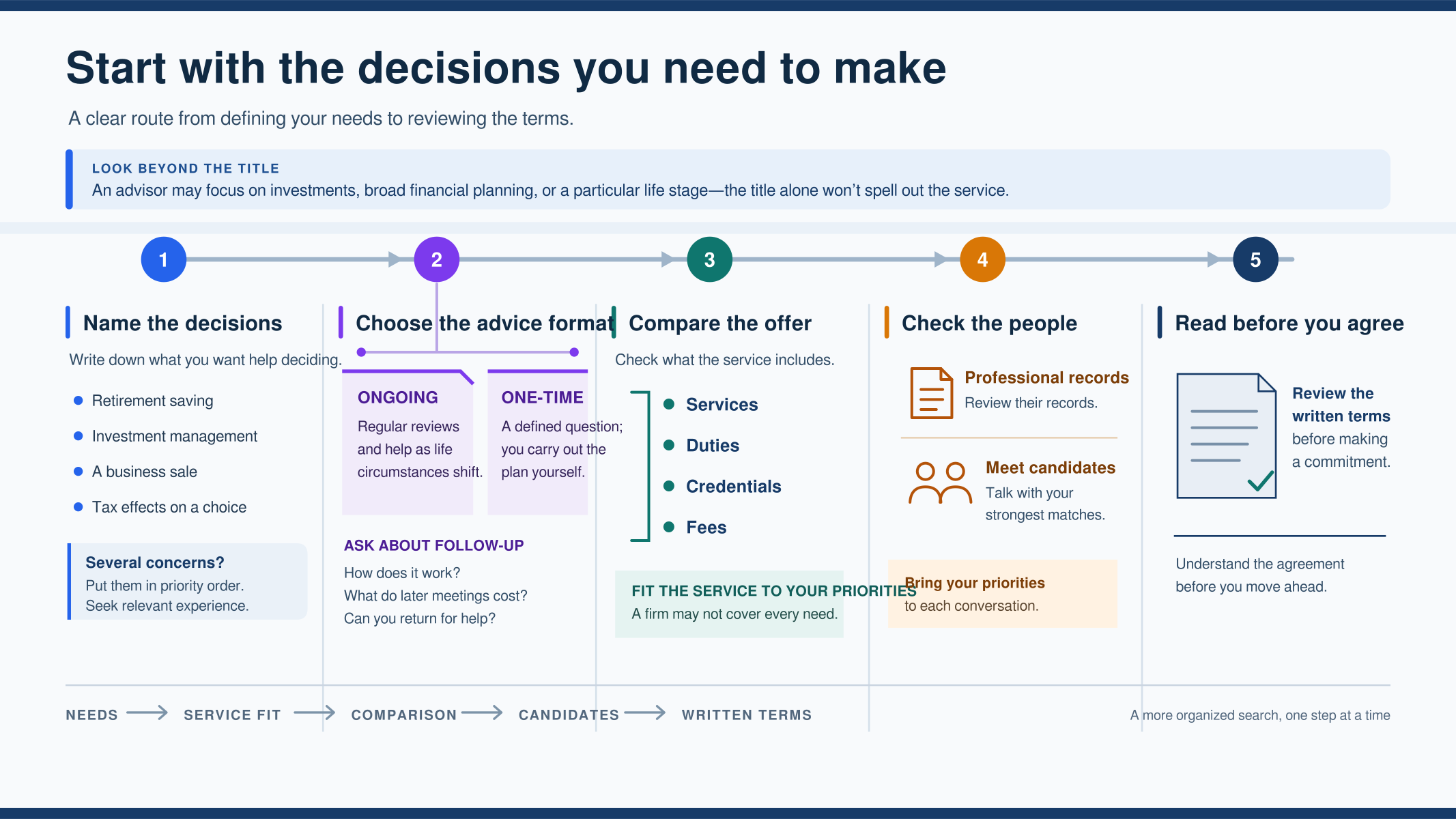
Start with your needs, then find professionals whose services match them. A financial advisor may focus on investments, broader financial planning, or a particular life stage, so the title alone won’t tell you what you’ll receive. Use this sequence to keep your search organized:
- List the decisions you want help with.
- Choose between ongoing guidance and a one-time plan.
- Compare advisor services, duties, credentials, and fees.
- Check professional records and meet your strongest candidates.
- Review written terms before you agree to anything.
For a useful overview of common selection factors, you can also review NerdWallet’s guide to choosing an advisor.
Define What You Need Help With
Write down the specific decisions you want to make. You might need help setting a retirement savings plan, managing investments, planning around a business sale, or understanding how taxes affect a financial choice. If you have several concerns, rank them. A clear list helps you find an advisor with relevant experience and makes it easier to spot when a firm’s services don’t cover your priorities.
Decide Whether You Want Ongoing or One-Time Advice
Ongoing advice may suit you if you want regular reviews and help as your circumstances change. A one-time plan may be a better fit when you need guidance on a defined question and feel comfortable carrying out the recommendations yourself. Ask how follow-up works, what future meetings cost, and whether you can return for help later. Vanguard’s advisor guidance can help you think through service needs before comparing providers.
Check the Advisor’s Fiduciary Duty

Ask each candidate whether they act as a fiduciary, what that means in your situation, and when the duty applies. Don’t rely on a general assurance that the advisor puts clients first; ask for the answer in writing and read the firm’s disclosures. Financial professionals can work under different standards depending on their role and the service they’re providing. For background on investment advisers and their role, see FINRA’s investor information.
Understand What Acting as a Fiduciary Means
A fiduciary is expected to put a client’s interests ahead of their own when providing advice within the relevant relationship. That expectation matters, but it doesn’t tell you everything about a professional’s services, compensation, or possible conflicts. Ask how the advisor identifies conflicts and what steps they take to address them. Get clear examples tied to the recommendations they may make for you.
Ask When and How the Duty Applies
Find out whether the fiduciary duty applies to every service you’re considering or only to certain recommendations. Ask who provides advice, whether other professionals may be involved, and which legal entity you’ll work with. Request the firm’s written explanation, including any situations where another standard may apply. If the answer is vague or changes during the conversation, pause and ask for clarification before moving forward.
Compare Credentials and Relevant Experience

Credentials can show that an advisor has completed training or met professional requirements, but they don’t guarantee good judgment or a strong fit. Check what each designation requires and whether it relates to the work you need. Then ask about the advisor’s experience with clients facing similar decisions. The University of Michigan’s planner selection guidance also highlights the value of checking qualifications and trustworthiness.
Review Professional Certifications
Ask what credentials the advisor holds, which organization issued them, and how the professional maintains them. A certification may involve education, an examination, work experience, or continuing study, depending on the designation. Look up the credential with its issuing body instead of relying only on a business card. Also ask whether the advisor is licensed or registered for the specific services being offered.
Look for Experience With Situations Like Yours
Relevant experience is more useful than a long list of impressive-sounding specialties. If you’re selling a business, caring for a family member, or approaching retirement, ask how the advisor has handled similar planning needs. They should explain their process without promising a particular result or sharing another client’s private details. Notice whether their answers address your circumstances rather than steering every conversation toward the same solution.
Understand the Advisor’s Services and Approach

Get a clear description of what the advisor will do and what remains your responsibility. Ask for the service list, the planning process, and the way recommendations are delivered. Then discuss how investment choices are made and reviewed. If you need help beyond investing, such as cash-flow planning or retirement decisions, confirm that the advisor offers it or can coordinate with another professional.
Check Which Financial Planning Services Are Included
Ask whether planning includes goals, saving, debt, retirement, taxes, insurance, or estate considerations and which topics cost extra. A written plan may be a document, a series of recommendations, or an ongoing working process. Find out how often it’s updated and whether the advisor helps you act on it. University of Wisconsin–Madison Extension’s overview offers a helpful starting point for thinking about financial planning.
Ask How Investment Decisions Are Made
Ask how the advisor builds a portfolio, how risk is considered, and what could lead to a change in your investments. Find out whether recommendations are individualized or based on set model portfolios, and whether the firm receives compensation from investment providers. You don’t need to predict market returns. You do need an explanation you can understand, including how the strategy relates to your goals and comfort with losses.
Compare Advisor Fees and Compensation

Ask for the full cost in writing before agreeing to a service. Advisors may charge a flat or hourly fee, a recurring fee, a percentage tied to assets managed, commissions, or a combination. Each structure can affect your total cost differently. Compare what you’ll pay for the same type of service, and ask whether payment changes when an advisor recommends one product or account over another.
A fee is easier to judge when you know exactly what it covers, when it’s charged, and whether anyone else may be paid as part of the recommendation.
Learn How the Advisor Gets Paid
Ask the advisor to explain every source of compensation in plain language. If a fee is based on assets, request a written example using your likely account balance. For instance, at a hypothetical annual fee of 1% on $200,000, the fee would be $2,000 for a year before other costs. That example is arithmetic, not a suggested or typical rate; ask candidates for their actual terms.
Ask About Additional and Indirect Costs
Investment expenses, account charges, trading costs, and fees from outside professionals may sit beyond the advisor’s own fee. Ask which costs apply, who receives them, and whether they can change. Request a written estimate that separates advice fees from investment and account expenses. If a candidate can’t explain the total clearly, you won’t have a fair basis for comparing offers.
Verify the Advisor’s Background and Disclosures

Check professional records before you hire anyone, and make sure the information matches the person and firm you met. In the United States, registration and disclosure resources can vary by professional role. Ask the advisor which official records apply and where to find them. The Consumer Financial Protection Bureau’s guide to choosing a financial professional explains why it’s important to understand what kind of professional you’re considering.
Check Registration and Professional Records
Use the relevant regulator or professional organization to confirm registration, licenses, and business details. Check the individual as well as the firm when the search tool allows it. Compare names, locations, and employment history with the information the advisor gave you. If you can’t find a record, ask why before drawing a conclusion; a professional may not be required to register for every kind of planning service.
Review Disciplinary History and Conflicts of Interest
Read disclosures carefully and ask the advisor to explain any disciplinary events, complaints, or conflicts you don’t understand. A disclosure deserves context, not an automatic assumption about what happened or what it means for you. Ask how the firm handles referrals, product payments, and outside business interests. If anything seems inconsistent, seek clarification directly from the regulator or professional body before signing.
Assess Communication Style and Personal Fit

Your advisor should make complex choices easier to discuss, not harder. Agree on how often you’ll meet, how you can ask questions between meetings, and who will respond. Then notice whether the advisor listens carefully and explains trade-offs without rushing you. Compatibility matters because a sound plan only helps when you understand it and can talk openly about changes in your life.
Discuss Meeting Frequency and Contact Options
Ask whether meetings are in person, by phone, or online, and how often reviews usually happen. Find out whether you’ll contact the advisor directly or work with a service team. Clarify how urgent matters are handled and when you can expect a reply. If you prefer a brief check-in every few months, say so and confirm that the proposed service includes a schedule that works for you.
Consider Whether You Feel Heard and Understood
Pay attention to whether the advisor asks about your priorities before proposing a solution. They should explain unfamiliar terms in everyday language and welcome reasonable follow-up questions. You don’t have to agree with every recommendation, but you should understand the reasoning and feel comfortable raising concerns. A first meeting is also your chance to notice whether the advisor respects your time, privacy, and decision-making pace.
Ask These Questions Before Hiring a Financial Advisor

Prepare questions and ask each candidate the same core ones. This makes answers easier to compare and helps you notice what an advisor avoids. Keep notes during meetings, and ask for written material when an answer involves fees, services, or legal duties. You can review the candidate’s explanation afterward instead of trying to remember every detail.
Questions About Services, Fees, and Conflicts
Ask: “What services are included, and what costs extra?” “How are you and your firm paid?” “Do you receive commissions, referral payments, or other compensation?” “When do you act as a fiduciary for me?” Then ask who will work on your account and whether you can end the relationship without an additional charge. Clear answers should match the written agreement and disclosures.
Questions About Planning, Performance, and Communication
Ask how recommendations will connect to your goals, how the advisor considers risk, and how often your plan is reviewed. Instead of asking for a promised return, ask how the advisor evaluates progress and responds when markets or your circumstances change. Confirm how often you’ll meet, who handles everyday questions, and what happens if your main contact leaves. Fidelity’s advisor selection guide also emphasizes finding a professional whose communication style suits you.
Compare Candidates and Watch for Warning Signs
After your meetings, compare candidates using the same criteria rather than relying on one strong impression. A brief scorecard can keep the decision grounded. Give each candidate a simple rating, such as 1 to 5, for each area, then write one reason for every rating. Treat the numbers as a way to organize your thinking not as a precise measure of future results.
| What to compare | What to confirm |
|---|---|
| Services | Does the offer address your stated needs? |
| Duty and conflicts | Are the advisor’s role and disclosures clear? |
| Fees | Can you explain the total cost and payment method? |
| Experience | Has the advisor worked with similar planning needs? |
| Communication | Do the meeting plan and response options suit you? |
Use a Consistent Checklist to Compare Advisors
Compare the written proposals side by side. Check whether each covers your priorities, explains its fees, identifies the person responsible for your account, and describes how you’ll receive advice. Note missing information as a follow-up item rather than guessing. A candidate who costs more may offer broader planning, while a lower-cost option may focus on a narrower service. Decide whether the difference is useful to you.
Recognize Pressure Tactics and Unrealistic Promises
Be cautious if someone urges you to sign immediately, guarantees investment results, discourages you from checking records, or avoids explaining fees. Don’t transfer money or share account access just because a meeting felt persuasive. Take time to review documents and discuss them with a trusted professional if needed. If a candidate won’t answer basic questions or provide written terms, you can simply keep looking.
Conclusion
To choose a financial advisor, begin with the decisions you need help making. Then compare the advisor’s duties, credentials, relevant experience, services, fees, records, and communication approach. Ask every candidate consistent questions, read the written terms, and check that the proposed relationship fits your needs. This process takes more than a quick search, but it gives you a clearer basis for a thoughtful choice.
The right advisor isn’t necessarily the one with the most impressive title or the broadest service list. Look for someone whose expertise matches your situation, whose compensation you understand, and whose explanations help you make informed decisions. If you’re not ready for ongoing support, a one-time planning engagement may be a better starting point. If you’re comparing offers, pause whenever an important fee, duty, or service remains unclear.
Once you’ve chosen, keep copies of your agreement and disclosures, and set a date to review whether the relationship is meeting your expectations. Your financial needs can change, so it’s reasonable to revisit the fit over time. A careful selection gives you a stronger foundation for planning, without handing over responsibility for understanding your own financial choices.
Frequently Asked Questions
Frequently Asked Questions
How do financial advisors charge, and how can I compare their costs?
What is the difference between a fee-only and a fee-based financial advisor?
How can I check a financial advisor’s registration and disciplinary history?
What should I review before signing a financial advisory agreement?
What questions should I ask during an initial meeting with a financial advisor?
What are warning signs that a financial advisor may not be a good fit?
How can I tell whether a financial advisor’s communication style will work for me?
What can I do if I want to stop working with my financial advisor?
Sources
- How to Choose a Financial Advisor | Edward Jones
https://www.edwardjones.com/us-en/working-financial-advisor/how-choose-financial-advisorEdward Jones outlines five steps for choosing a financial advisor.
- How to Find a Financial Advisor – NAPFA
https://www.napfa.org/financial-planning/how-to-find-an-advisorThe National Association of Personal Financial Advisors presents five steps for finding a financial advisor.
- How To Choose a Financial Advisor
https://www.edelmanfinancialengines.com/education/financial-planning/how-to-choose-a-financial-advisorEdelman Financial Engines provides a guide to choosing a financial advisor.
- How to Choose a Financial Advisor in 5 Steps – NerdWallet
https://www.nerdwallet.com/financial-advisors/learn/how-to-choose-a-financial-advisorNerdWallet’s guide outlines five steps for choosing a financial advisor.
- How to choose a financial advisor – Vanguard
https://investor.vanguard.com/investor-resources-education/article/how-to-choose-a-financial-advisorVanguard’s guide explains how to choose a financial advisor.
- Choosing a financial professional – files.consumerfinance.gov.
https://files.consumerfinance.gov/f/documents/cfpb_servicemembers_choosing-a-financial-professional.pdfThis Consumer Financial Protection Bureau document discusses choosing a financial professional, including when financial planners may need to register with regulators.
- How to find and choose a financial advisor – Fidelity Investments
https://www.fidelity.com/learning-center/smart-money/how-to-find-a-financial-advisorFidelity’s guide covers evaluating financial advisor candidates for trust, compatible communication, and understanding of your values.
- Choosing a Financial Planner
https://hr.umich.edu/benefits-wellness/financial/retirement-savings-plans/annual-savings-tune-financial-advisors/choosing-financial-plannerThe University of Michigan guide highlights credentials and trustworthiness when choosing a financial planner.
- Investment Advisers | FINRA.org
https://www.finra.org/investors/investing/working-with-investment-professional/investment-advisersFINRA explains what investment advisers are, describing them as individuals or companies paid to advise clients about securities.
- University of Wisconsin–Madison Extension’s overview
https://finances.extension.wisc.edu/articles/how-to-choose-a-financial-advisorThe University of Wisconsin–Madison Extension provides an overview of how to choose a financial advisor.
- How does one choose a financial planner? : r/FinancialPlanning
https://www.reddit.com/r/FinancialPlanning/comments/1ilu53v/how_does_one_choose_a_financial_plannerA Reddit discussion in r/FinancialPlanning asks how to choose a financial planner.