
Introduction
Business growth doesn’t come from doing more of everything; it comes from doing more of what works. For entrepreneurs, that means building a business around clear customer needs, sound financial choices, and systems that can handle rising demand. A thoughtful growth plan can help you increase sales without stretching your cash, team, or time beyond what the business can support.
This guide walks you through practical business growth strategies for entrepreneurs, from setting measurable goals to improving customer retention, pricing, operations, and cash flow. You’ll learn how to choose actions that fit your business instead of chasing every new channel or opportunity. The aim is steady, sustainable progress not growth for its own sake.
Start with what you know: which offer customers value, where your strongest leads come from, and what limits your capacity today. Then use the steps below to decide what to improve first. If you’re still shaping your plan, the U.S. Small Business Administration’s business plan guide can help you organize your goals, market understanding, and financial thinking.
Key Takeaways
- Choose focused, measurable growth priorities: Set one or two clear priorities and track both progress and business health, including qualified leads, conversion rates, gross margin, and cash balance.
- Grow by understanding and retaining the right customers: Use customer conversations, feedback, and sales records to identify who values your offer. Make buying, getting support, and returning straightforward, then track repeat business and complaints.
- Build a repeatable marketing and sales process: Start with channels that fit your audience, track qualified leads, and guide prospects consistently from inquiry to purchase. Improve conversion before spending more to attract leads.
- Expand offers and pricing based on customer needs and costs: Test related offers that address proven requests, and set prices that account for delivery, overhead, and support costs. Review sales, customer feedback, and margins before scaling changes.
- Prepare operations and cash flow before expanding: Delegate clearly defined tasks, document repeatable processes, and forecast incoming and outgoing cash. Test new opportunities on a limited scale with a spending cap and criteria for continuing.
Business Growth Strategies for Entrepreneurs That Build a Strong Foundation

Before you spend more on marketing or hiring, make sure your business has a clear direction. Choose one or two growth priorities, such as increasing repeat purchases or expanding into a nearby customer segment. A focused plan makes it easier to see whether your effort is paying off.
Set Measurable Goals and Track the Right Metrics
Turn a broad aim like “grow revenue” into a target you can review regularly. For example, you might aim to raise monthly sales from $20,000 to $24,000 over six months, then track leads, conversion rate, repeat orders, and gross margin. Choose measures that show both progress and business health; more sales aren’t helpful if each order costs too much to deliver.
| Growth question | Useful measure | What to check |
|---|---|---|
| Are more prospects finding you? | Qualified leads | Lead source and fit |
| Are sales improving? | Conversion rate | How many leads become customers |
| Can growth support the business? | Gross margin and cash balance | Delivery costs and available cash |
Strengthen Your Value Proposition
Explain who you help, what problem you solve, and why your approach suits that customer. Keep the message concrete: a bookkeeping firm might promise clearer monthly reporting for independent contractors, rather than simply calling itself “full service.” Ask recent customers what made them choose you, then check whether your website and sales materials make that advantage easy to understand.
Find and Retain the Customers Most Likely to Grow With You

Growth is easier to sustain when you know which customers value your offer and are likely to return. Rather than trying to appeal to everyone, learn what your best-fit customers need and make their experience reliable.
Use Customer Research to Focus Your Marketing
Review sales conversations, support requests, and customer feedback for repeated needs. Ask a few current customers what they were trying to solve before they found you, what nearly stopped them from buying, and what they value most now. Combine those answers with basic sales records to spot patterns. The SBA’s market research guide offers a useful starting point for assessing customers and competitors.
Build Loyalty Through Consistent Customer Experience
Make it easy for people to buy again, get help, and understand what happens next. Set clear response times, send accurate order or project updates, and resolve problems without making customers repeat themselves. A simple follow-up after delivery can uncover issues early and invite useful feedback. Track repeat business and common complaints so you can improve the experience, not just promote it.
Create a Marketing and Sales System That Can Scale
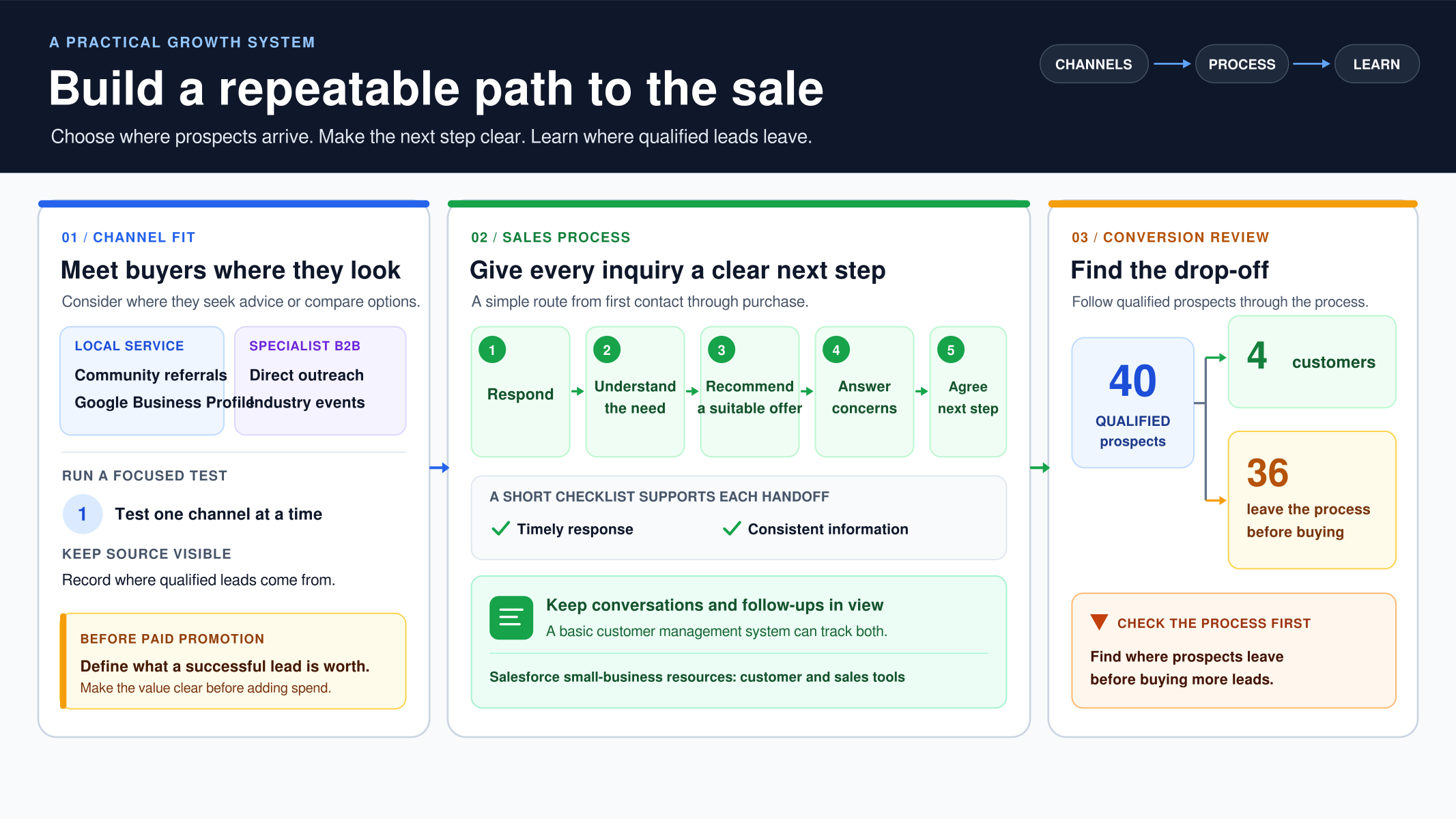
A repeatable system helps you find prospects and guide them toward a purchase without relying on last-minute outreach. Start with one or two channels you can manage well, then improve the steps between first contact and sale.
Choose Channels That Match Your Audience
Pick channels based on where your customers seek advice or compare options. A local service business might benefit from community referrals and a clear Google Business Profile, while a specialist B2B firm may find direct outreach and industry events more useful. Test one channel at a time, record where qualified leads come from, and avoid adding paid promotion until you can explain what a successful lead is worth.
Improve Conversions With a Clear Sales Process
Map the path from inquiry to purchase: respond, understand the need, recommend a suitable offer, answer concerns, and agree on the next step. Use a short checklist so every prospect gets timely, consistent information. If 40 qualified prospects produce 4 customers, review where the other 36 leave the process before buying more leads. A basic customer management system can help you track conversations and follow-ups; Salesforce’s small-business resources cover customer and sales tools.
Expand Revenue With the Right Products and Pricing

More revenue can come from serving an existing need better, adding a related offer, or adjusting prices to reflect the work involved. Choose based on customer evidence and delivery capacity, not simply on what competitors appear to charge.
Develop Offers Around Proven Customer Needs
Look for repeated requests that fit your skills and can be delivered consistently. If clients regularly ask a design studio for help after a website launch, a maintenance package may solve a real follow-up need. Test the offer with a small group before building a large product line. Harvard Business School Online’s growth strategy overview can help you think through opportunities and the value they may create.
Set Prices That Support Sustainable Growth
Include materials, labor, overhead, payment fees, and the time needed for customer support when reviewing a price. Then compare the total cost with the value customers receive and the margin your business needs. If a service takes 10 hours to deliver, price it with those hours and the surrounding work in mind not just the time spent in a customer meeting.
A useful offer solves a real customer problem at a price that also leaves your business room to deliver it well.
Test changes carefully and explain them clearly to customers. You might begin with new customers or a newly defined package, then review sales, feedback, and delivery costs before applying the change more widely. Avoid adding discounts without knowing how they affect your margin.
Build a Team and Operations That Keep Up With Demand

When every decision and task depends on you, growth can create delays instead of progress. Identify work that needs your judgment and work that someone else can handle with clear instructions.
Delegate Work and Hire for Key Capability Gaps
List recurring tasks that take time away from sales, planning, or customer relationships. Delegate a task when you can describe its expected result, deadline, and decision limits. If you hire, start with the capability that solves a real bottleneck, such as scheduling or customer support, rather than adding roles without a defined need. For guidance on planning responsibilities and staffing, explore SCORE’s small-business mentoring and resources.
Standardize Processes Before Bottlenecks Appear
Write down the steps for work you repeat, such as onboarding a client, preparing an order, or handling a refund. A short checklist can reduce missed details and make it easier to train new team members. Review the process after a mistake or delay, then update the instructions. Keep the steps practical; a process should help people do good work, not bury them in paperwork.
Manage Cash Flow and Reduce the Risks of Expansion
A business can make sales and still face a cash shortage if payments arrive later than bills are due. Before expanding, understand when money comes in, when it goes out, and what could change if sales grow more slowly than expected.
Forecast Cash Needs Before Committing to Growth
Build a simple forecast that lists expected customer payments, payroll, supplier costs, taxes, loan payments, and planned spending. Look at the next 12 to 13 weeks and update the forecast as invoices are paid or plans change. If you expect to spend $8,000 on equipment, include the purchase date and estimate how much cash remains afterward. The FDIC’s Money Smart resources for small businesses can support financial planning.
Test New Growth Opportunities in Manageable Steps
Try a small, time-limited test before committing to a major expansion. For example, offer a new service to 10 existing customers or promote it in one location for a month. Set a spending limit and decide in advance what results would justify continuing, such as paid orders, repeat interest, or a workable delivery cost. If the test falls short, use what you learned to adjust the offer or stop before the expense grows.
Conclusion
To thrive with business growth strategies for entrepreneurs, build from fundamentals: know your customers, make your offer clear, measure progress, and protect the cash and capacity your business needs. These choices help you distinguish useful growth from activity that only adds cost or complexity. You don’t need to change every part of the business at once.
Choose one priority for the next 90 days. Set a measurable goal, identify the steps that influence it, and review a small set of indicators each week or month. That might mean improving repeat orders, testing a new service, or reducing a delay in your sales process. Keep what works, and revise what doesn’t.
As results become clearer, invest in the next constraint: customer research, a better sales routine, a key hire, or stronger cash planning. Sustainable growth comes from making sound decisions repeatedly, then giving successful changes enough time to work. With a clear plan and steady reviews, you can expand with more confidence and keep your business ready to serve customers well.
Frequently Asked Questions
Frequently Asked Questions
How can I tell whether my business is ready to grow?
What should I do if sales are increasing but cash is tight?
Should I take out a loan to fund business growth?
How can I grow without taking on too much financial risk?
When should I hire employees instead of using contractors or outside help?
How can I choose between entering a new market and launching a new product?
What signs suggest my business is growing faster than it can handle?
When should I get outside help with a growth plan?
Sources
- Small Business Growth Strategies for 2025 | CO
https://www.uschamber.com/co/start/strategy/best-small-business-growth-strategiesThe U.S. Chamber of Commerce’s CO guide presents 15 strategies for starting or enhancing a small business.
- 3 Strategies for Small Business Growth
https://www.efund.org/blog/3-strategies-for-small-business-growtheFund outlines three small-business growth strategies: business advising, working-capital loans, and networking.
- How to Grow Your Business (6 Strategies)
https://www.salesforce.com/small-business/how-to-grow-your-businessSalesforce describes strategies for growing a business, including expanding market reach, adding products or services, and improving customer retention.
- 4 Things to Help Your Small Business Thrive in 2025
https://www.oldnational.com/resources/insights/4-things-to-help-your-small-business-thrive-in-2025Old National Bank highlights four ways to help a small business thrive in 2025; its description emphasizes active listening and clear, empathetic communication.
- Plan your business – Small Business Administration
https://www.sba.gov/counseling/plan-your-businessThe SBA’s business-planning resource covers planning and future strategic financial plans, such as paying off debt or selling a business.
- Manage your business – Small Business Administration
https://www.sba.gov/counseling/manage-your-businessThe SBA’s business-management resource highlights measuring and updating a business plan.
- 10 Reasons All Business Owners Should Plan
https://www.sba.gov/sba-newsroom/2016/11/30/10-reasons-all-business-owners-should-planThe SBA article presents reasons for business owners to plan, including projecting sales, spending, and cash flow.
- Decoding Your Business Health: A Guide to Financial …
https://www.sba.gov/event/87676This SBA event page focuses on business financial health, cost-cutting opportunities, and KPIs related to long-term viability.
- Free small business counseling & local mentoring
https://www.sba.gov/counselingThe SBA counseling page lists local resources, guides, tools, training, and events for entrepreneurs starting and growing businesses.
- Marketing and sales | U.S. Small Business Administration
https://www.sba.gov/business-guide/manage/marketing-sales-plan-paymentThe SBA guide covers marketing and sales goals, with examples such as increasing email subscribers, market share, or sales.
- Strategic Growth for Businesses | U.S. Small Business …
https://www.sba.gov/event/87560The SBA event page is titled “Strategic Growth for Businesses.”
- Grow your business – Small Business Administration
https://www.sba.gov/counseling/grow-your-businessThe SBA’s business-growth resource notes that forecasts can draw on judgment, quantitative analysis, or both.
- Market research and competitive analysis
https://www.sba.gov/starting-business/how-start-business/understand-your-marketThe SBA guide explains how market research can help businesses find customers and conduct competitive analysis.
- U.S. Small Business Administration’s business plan guide
https://www.sba.gov/business-guide/plan-your-business/write-your-business-planThe U.S. Small Business Administration’s guide to writing a business plan.
- SBA’s market research guide
https://www.sba.gov/business-guide/plan-your-business/market-research-competitive-analysisThe U.S. Small Business Administration’s guide to market research and competitive analysis.
- Salesforce’s small-business resources
https://www.salesforce.com/small-businessSalesforce’s small-business resources.
- Harvard Business School Online’s growth strategy overview
https://online.hbs.edu/blog/post/business-growth-strategiesHarvard Business School Online’s overview of business growth strategies.
- SCORE’s small-business mentoring and resources
https://www.score.orgSCORE’s small-business mentoring and resources.
- FDIC’s Money Smart resources for small businesses
https://www.fdic.gov/resources/consumers/money-smart/learn-money-smart/for-small-businessesThe FDIC’s Money Smart resources for small businesses.
- Business Growth Strategies
https://www.workboard.com/resources/blog/business-growth-strategiesWorkboard’s page on business growth strategies, framed around the question of four major strategies.
- 5 Effective Business Growth Strategies for Scaling in …
https://www.thestrategyinstitute.org/insights/5-effective-business-growth-strategies-for-scaling-in-the-modern-economyThe Strategy Institute’s article on five business growth strategies for scaling.